Component
Two
- Give two examples and descriptions of
products (and the companies where they are produced) which are commercially available and
directly related to the NCT application your team has selected.
The first product we
have found that is relevant to our product idea is called MillenniaTM.
Millennia is made by BP Solar. Millennia
photovoltaic (PV) modules utilize "tandem-junction" thin film technology to
transform light into electricity. Tandem-junction is their process of combining two
layers of thin film solar cells each converting a different portion of the electromagnetic
spectrum into electricity, thereby improving the film's efficiency. Manufacturing these
modules requires less silicon and energy than traditional PV modules making them less
expensive and more environmentally friendly to produce and implement in BIPV systems.
These modules have a higher productivity in hot field conditions than crystalline
products, making them ideal for our awning application.
The second product that we feel is
related to our project is another type of thin film solar cells made by Sustainable Technologies Australia
called titania solar cells.
Titania cells have some excellent
advantages over other solar cells including the ability to perform well in low light
and shade, a lower sensitivity to angle of radiation, consistent performance over a wide
range of temperatures, and production as either colored-transparent or opaque glass.
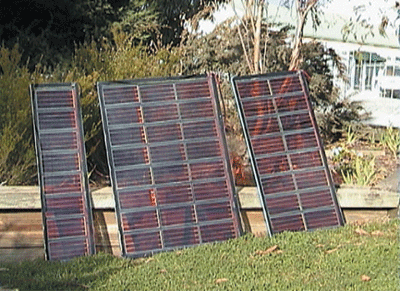
Image used with the permission of STA
Production facilities for titania cells
utilize commonly available non-vacuum processing equipment - vastly cheaper than
facilities required for manufacture of silicon solar cells; and their manufacture produces
no toxic gas emissions.
These cells are used in conjunction with
the SMART windows where a voltage applied for a short period of time will change the
optical state of the window. The electrochromic effect in the SMART Window has a memory,
therefore it does not require continuous power. The "low e state" transmits most
light, while the "heat reject state" transmits some visible light and rejects
almost all infrared radiation. SMART Windows range in size from 30 cm squares to panels 90
cm by 120 cm.
- Identify a product or trade organization
affiliated with the products you identified, describe their mission, number of companies
involved and economic importance.
As a non-profit organization,
International Solar Energy Society, ISES, was first formed in 1954. This organization
allows for the exchange of information concerning solar energy. With more than 4,000
members from more than 105 countries, ISES is widely known for promoting the development
of renewable energies.
Membership in the American Solar Energy Society (ASES) ranges
throughout the United States. Of particular interest to our team was the fact that two of
their chapters are based in Florida and one is an educational chapter affliated with the
University of Florida.
As an individual member of the ASES, one
has the opportunity to remain informed, influential, and involved in the development of
their profession as they join other people who share an interest in advances in solar
energy: architects, engineers, researchers, scientists, builders, government officials,
utility representatives, activists and consumers. As ASES members, corporations share
common interests for the safe and positive advance through the use of solar technologies.
The benefits of becoming an ASES
corporate member include: a subscription to SOLAR TODAY magazine, publications
discounts, conference registration discounts and full voting privileges.
In conjunction with our project a
division of ASES is solar buildings that promotes the efficient use of solar energy. It
also emphasizes related technologies in architecture, engineering, planning, construction,
design and research.
As a member, annual conferences are
available for participation. The National Solar Energy Conference facilitates the exchange
of information concerning solar energy technologies. Presentations are given by leaders in
technical and professional fields. Take a moment and view some highlights
from the past two conferences, SOLAR 99
and SOLAR 2000.
- Propose a new product or process based on
the team's NCT application, provide details regarding possible customer base, suggested
retail price (per unit) and projected sales of product for years 1 through 3.
Our proposed product is an awning with
integrated photovoltaics. Click here to view further details about our product.
The primary economic benefit of our product is energy utilization. In the 21st century,
there has been a tremendous increase in power prices especially in the state of
California. On Monday, December 18, 2000 the Los Angeles Times reported that the
"Utilities are billions of dollars in debt, power supplies have become so fickle that
businesses risk losing millions, Christmas light displays have become a symbolic casualty,
and higher rates loom for consumers as California copes with its most significant energy
crisis in two decades."
Photovoltaics (PV) are extremely
important because of their ability to convert sunlight directly into electricity.
Currently, they are used in things such as roadside phones, heating pools and suburb
homes, saving consumers millions of dollars annually. PV products have gained popularity
in the market due to increased concern about global warming and as a result of falling
prices due to technological breakthroughs. Due to the power crisis and deregulations, the
U.S. electric power industry of $250 billion will bring changes that will significantly
impact the demand for solar energy in the U.S. and abroad. This will eventually provide
opportunities for growth both in the solar and utility industry. There are more than 10,000 homes in the United States that are
now entirely powered by solar energy. In 1996, the world wide sales of photovoltaic
experienced a 14% increase
from the previous year, totaling over 90 megawatts. U.S. controls about 43% of this $1
billion global market. It is expected that the U.S. market for PV on buildings could top $2.5 billion in the next decade
with Japanese and European markets having similar growth. The fastest growing markets
for photovoltaic systems include the utility, rural electrification, telecommunications
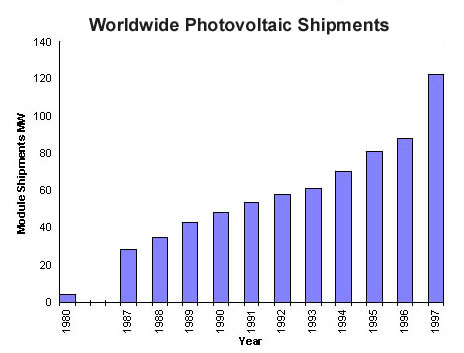
and military sectors. The graph below shows market growth for PV products over time.
Courtesy of Australian CRC For Renewable Energy,
Ltd
The cost of installing a typical off-grid PV
system ($15,000 to $20,000 per kilowatts) is less than the cost of extending electric
power lines ($20,000 to $80,000). This saving alone could pay for the PV system, with the
homeowner saving money on the electric bill in the long term.
Courtesy of Australian CRC For Renewable Energy,
Ltd
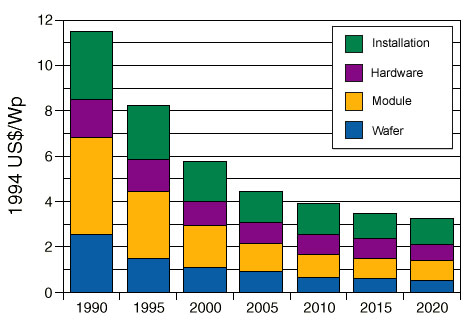
The above graph shows component costs of PV system and price reduction
over time. As the installation cost decreases over the years, the consumer will be
able to benefit more quickly. Our customer base is home, hotel/motel, and other business
owners. For a range of prices, our product can be custom installed above the windows on
any building.
Based on our research, through emails and
web-based catelogues, the cost for the materials required to install a 10 kW system
comprised of 245 awnings would be approximately $256,000. The cost is broken down in the
following manner:
- $1000 per awning, or $245,000 for 245 awnings.
- $175 for Millennia Module MST-43
- $750 for a support system
- $10,500-$11,000 for the building's components
- $7000 for a 10 kW inverter
- $1100 for a 10 kVA isolation transformer
- $2500 for wiring, combiner boxes, disconnects
Although at first this price may seem too
high, the consumer eventually benefits in the long term. Consumers should also make use of
other energy saving products such as solar water heaters, reflective roofs, solar energy
shingles, double-paned or smart windows, and efficient lighting to reduce their overall
electric bill.
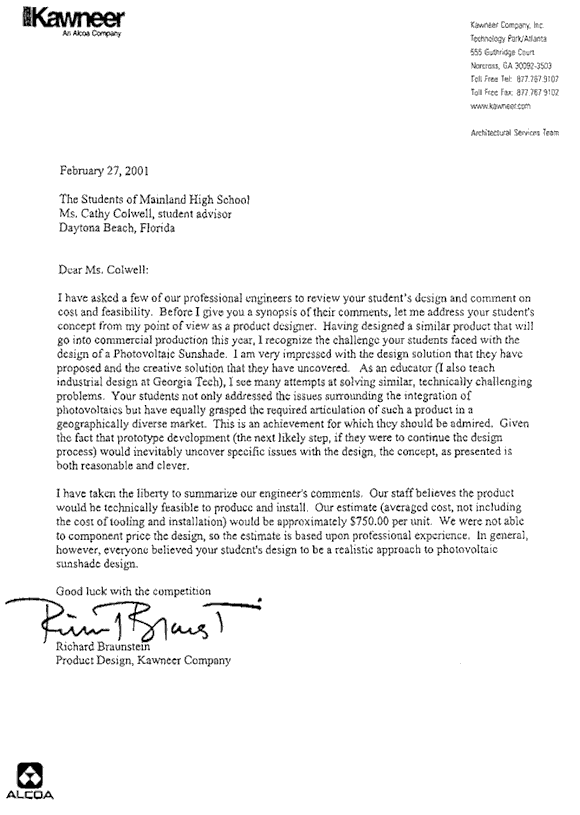
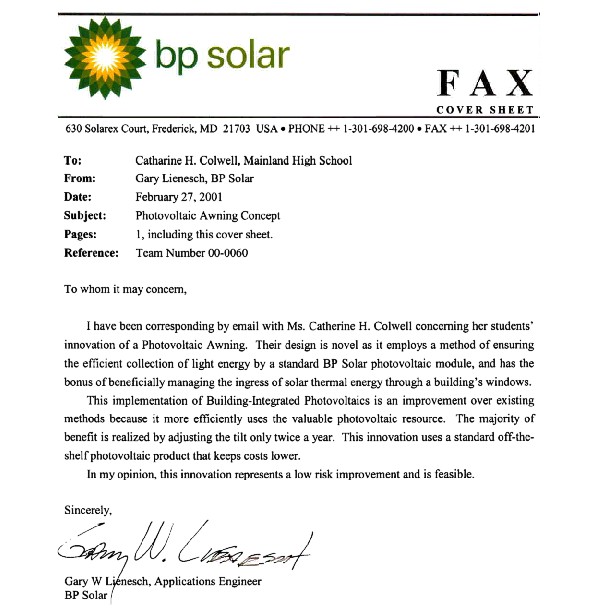
- Via e-mail locate a company that might
manufacture your proposed product and ask them to evaluate what you have proposed.
|