Component
One
- Prepare a 200- to 300-word history about
the National Critical Technology’s technical application the team has selected.
Edmund Becquerel first observed the
photovoltaic effect in 1839. However, it was not until 1904 that Albert Einstein explained
the physics behind the operation of photovoltaics, for which he won the Noble Prize in
1921. Selenium was discovered to be the first semiconducting medium in 1873 and was being
manufactured into wafers for solar cells by 1983.
The development of modern-day
photovoltaics began in the 1940's with the introduction of the Czochralski process which generated
highly pure crystalline silicon. In 1954, Bell Laboratories produced a 4% efficient
crystalline silicon cell using the Czochralski process that showed how PV cells, modules,
and arrays were examples of how this science could improve the lives of people all over
the world. That same year, a solar
battery converted six percent of incident sunlight into useful energy.
Today, we use solar cells to power
calculators, satellites, and communications equipment; they can light our homes, pump
water, run our appliances, and power highway emergency phones. In a surprising number of
cases, PV power is the least
expensive form of electricity for performing these tasks. Solar cells are making their
mark on our economy. Solar energy is becoming very efficient now that we have
achieved a high level of purity within the cells. Current industry leaders in solar cell
development can now convert over 30
percent of the incident sunlight into useful energy. Crystalline cell prices are going
down, usage has gone up, and advances in technology have increased.
- Cite three detailed examples of research
done in the past 3 to 5 years which focused on the NCT application the team selected.
Include: the funding agency, the principal investigator, the institution where the
research is or was being conducted, the amount of the dollar award granted for the
research, and the duration of the research grant.
1A. The first contract, from the DOE's
Photovoltaic Manufacturing Technology (PVMaT) Program, is for a $6.2 million project
spanning 3 years. AstroPower will
share 51% of the project cost. The overall goal of the program is to strengthen U.S.
photovoltaic industry leadership in the world market, and improve its competitive
advantage. In particular, AstroPower will use the funding to reduce manufacturing costs
and enhance solar cell performance of its newly introduced line of APex™ solar
electric power products.
1B. The second contract, from DOE's
Thin-Film Partnership Program, is for a $3.5 million project also spanning 3 years.
AstroPower will share 39% of the projected cost. The overall goal of this program is to
develop an advanced, thin-silicon-based photovoltaic module product. This development
effort will eliminate the labor intensive work of soldering many small solar cells
together during module fabrication while maintaining the proven performance, stability and
reliability of crystalline silicon solar cell materials.
Dr. Allen M. Barnett, President and Chief
Executive Officer of AstroPower, said "These [two grants] awards will further enhance
AstroPower's Silicon-Film™ technology position. PVMaT support has been critical to
the development of our newly introduced APex™ line, which is the first generation of
products to utilize our Silicon-Film™ manufacturing process. We anticipate that the
current awards will enable AstroPower to make further cost and efficiency improvements
with our APex™ products while designing and developing next generation products using
advanced Silicon-Film™ processes."
AstroPower recently invested in a new
manufacturing facility for the production of APex™ solar cells and modules. The new
factory is located in Newark, Delaware, approximately 6 miles from the Company's
headquarters. When operating at full capacity, the 60,000 square-foot facility will
produce approximately 9 megawatts of APex™ products per year, roughly tripling
AstroPower's current production capacity.
2. A Boone company and an Iowa State
research center are working to make a better light-trap with some newly received grants
worth almost $4 million.
Iowa Thin Film Technologies, Inc. (ITFT) of
Boone, in a joint project with ISU's Microelectronics Research Center, recently received
two contracts worth $3.7 million over five years for research and development on the
manufacturing of lightweight solar panels. Iowa Thin Film Technology makes lightweight,
flexible solar panels for electrical power generation using a unique thin film
photovoltaic material.
The company received $2.7 million from
the U.S. Department of Energy's National Renewable Energy Laboratory. "The purpose of
this grant is to develop and improve the technology to manufacture solar cells less
expensively and to improve their performance for more power per square foot", said
Iowa Thin Film Technologies, Inc (ITFT) President Frank Jeffrey. ITFT received an
additional $1 million from a $10 million consortium project with the federally funded
Advanced Research Project Agency to further develop the process of manufacturing the
modules. Jeffrey said, "The research funded by these grants will expand the
applications of solar technology by improving the performance of the material and reducing
the cost of production."
ITFT solar modules have many applications
according to Lynne W. Brookes, executive administrator at ITFT, including portable field
power for scientific, military and other outdoor uses and supplying power in space where
payload weights are important. "We have delivered a couple of modules to companies
who are using them on satellites going up," said ITFT President Frank Jeffrey.
"There is a program run by NASA called the Small Satellite Technology Initiative.
They are putting up a couple of small satellites with a lot of new technologies to try
out."
"What we learn from the research and
development is going to help us manufacture material at a lower cost," he said.
"Each time you chop down the cost a little bit, the markets that you can serve go up
quite a bit. Hopefully, by the end of the contract we will have manufacturing costs that
would make it cost effective to mount roof panels on houses in the U.S., and feed power
into the grid off those to compete with coal fire generation. We are really trying to
bring the costs down to the point where it is a strong cost-competitive technology in the
U.S."
3. On April 7th, Senator Robert
Hill, Minister for the Environment, announced a $1 million grant to Sustainable Technologies Australia, Inc.
(STA) to fund 50% of the costs of establishing a 500 kilowatt-plant to produce the STA new
generation solar cells - dye doped titania solar cells. Senator Hill choose to make the
announcement of the first round of grants under the Renewable Energy Commercialization
Program at the Queanbeyan laboratories of STA, which was awarded one of the 6 Photovoltaic
Manufacturing Technology (PVMaT) Program Grants.
- Based upon research conducted, explain how
the NCT application your team chose has advanced scientific knowledge.
Our NCT application of Renewable Energy
Sources has advanced scientific knowledge in several different ways. Along with a variety
of consumer products (calculators, watches etc.), the United States, Australia, Japan,
Switzerland, and Canada are developing new ways to use solar cell technology on a massive
scale as they cope with the current energy crises.
Some of the most remarkable applications
of solar cells include their uses in inaccessible locations such as mountain tops, middle
of an ocean, desert, and outer space. Radio transceivers on mountain tops and telephone
boxes in the country are beginning to be powered by solar technologies. Since they use
very little amount of power, the electricity needed for operation can be provided with PV
modules, in combination with a small battery.
In remote communities around the world,
the use of solar cells is providing important economic and social benefits. One benefit of
using solar cells in remote areas is that they have no fuel costs or fuel supply problems.
Another reason is that the equipment can usually be operated without constant supervision.
In addition, Solar cells are very reliable and require little maintenance.
One major area of science which has
advanced due to the use of solar cells is astronomy and propulsion of spacecraft.
"Photovoltaic solar generators have been and will remain the best choice for providing electrical
power to satellites in an orbit around the Earth." The first practical application of
photovoltaics was its use in the U.S. satellite Vanguard I in 1958. In space travel,
traditional internal combustion power is not feasible. Solar cell technology is efficient,
since the solar cell is light weighted and there is no heat or waste gas produced.
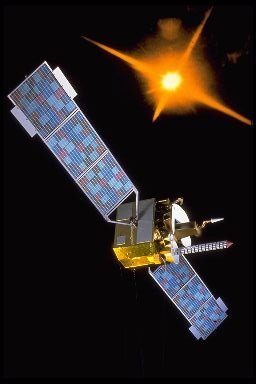
Image courtesy of University of Southampton |