Lighting
Options
| More than 37 billion dollars is used to
power our nation's lights. This equals about 1/4 of the money spent on electricity.
Lighting has drastically improved over the last decade and has helped cut costs from 30%
to 60% while reducing environmental impact and improving lighting quality. There are four basic types
of lighting: incandescent, fluorescent, high-intensity discharge, and low-pressure
sodium. In designing an energy-efficient building, the type of lighting utilized will
greatly decrease its energy demands. The team's recommendation would be to refrain from
using incandescent lights; and instead use fluorescent, low pressure sodium, and halogen
lights. |
|
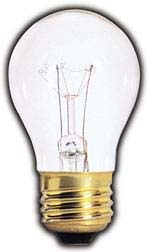
standard incandescent
Image courtesy of www.bulbs.com
|
Incandescent lighting is the most common type of
lighting that people use in their own homes. These type of bulbs are the least expensive
but waste 90 percent of the energy they use in producing heat rather than light. They
produce light when the tiny strip of tungsten wire inside the bulb has an electrical
current going through it. Though it has the shortest life span (usually between 750 and
2100 hours) it is the most popular bulb used in American homes. Benefits
- Incandescent lamps are popular for their warm, pleasing
color, which flatters skin tones
- They are less expensive to purchase, but due to their
relatively short life (1,000 hours on average), operating costs can be high
- Lifetime not affected by frequent switching on and off
- Excellent for use with dimmers
- Easy to find in stores
|
|
| Halogen bulbs where invented by GE is 1958. These bulbs
contain a tungsten filament similar to that in incandescents. The filament is enclosed in
a tiny quartz tube filled with pressurized halogen gas which lies within a larger bulb. Tungsten vaporized off the filament reacts with the halogen gas
and returns to the filament, creating a "halogen cycle" that permits the
filament to burn brighter. This results in a whiter, brighter light that is more intense,
more dramatic, and highly energy efficient. A 150-Watt lamp can be replaced with a 90-Watt
halogen flood lamp that gives the same usable light.
Halogen lamps are available in most of the common
incandescent lamp shapes and are ideal for use in track, recessed and spot lighting, and
in outdoor security and flood lighting.
Benefits
- Brilliant, intense, focused light
- Up to 2 times more light/square centimeter than
incandescents
- Small size allows less obtrusive fixtures
- Lasts up to 3x as long as incandescents
- Can be used with dimmers for extra energy savings
- Use 30% less energy than standard incandescent lamps
|
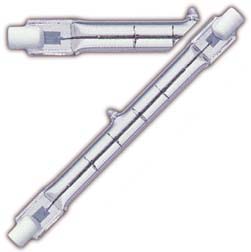
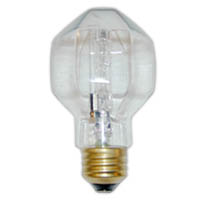
<halogen lamps
Image courtesy of www.bulbs.com
|
|
| A fluorescent lamp consists of a glass tube
with an electrode at each end. When turned on, high speed electrons are boiled from the
electrodes and are forced to vibrate at high speeds back and forth within the tube by the
applied AC voltage. When these high-speed electrons collide with those in the low-pressure
mercury atoms which fill the tube, ultraviolet light is produced. These UV photons in turn
excite the electrons in the phosphor coating that is along the inside of the glass tube
causing the tube to glow brightly. |
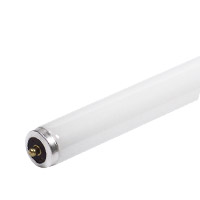
standard fluorescent
Image courtesy of www.bulbs.com
|
Fluorescent tubes need a ballast. When you switch on the
electricity, the current passes through the ballast, heats the electrodes, and regulates
the proper flow of power. Because the starting cycle is hard on the electrodes,
fluorescent tubes will burn out faster if you turn them on and off frequently. Fluorescent
lamps should principally be used in commercial indoor lamps where the lights will be on
for several hours, maximizing their efficiency. Benefits
- Consumes only 1/5 to 1/3 the electricity of an
incandescent of similar brightness
- Lasts 10 to 18 times as long, up to 20,000 hours
- Today's fluorescent lamps come in many appealing shades of
white, from warm to cool
- Soft, diffused light is excellent for shadowless general
lighting
|
|
| In recent years, compact fluorescent lamps
(CFLs) have been one of the best advances in lighting technology. By combining the
efficiency of fluorescent bulbs with the convenience of using them in incandescent
sockets, CFLs have become very popular. Recent CFLs are tinted so that they will emit the
same brightness and color of light so as to look exactly like incandescent bulbs. Their
ballasts are built into an adapter base with some models having an economical feature of
replaceable tubes, while others only come as all-in-one units. Unfortunately, these lamps
are not suitable for use with dimmer switches. |
| Though CFLs cost 10 to 20 times more than incandescents,
they can last up to 10,000 hours or 1 year of continuous use without the need to change a
bulb. Their life will be maximized if they are used in places where lights stay on for
hours at a time. CFLs are so efficient (3-4 times that of incandescent bulbs) that for
every incandescent lamp that is replaced with a CFL, there is the potential to save
600 pounds of coal, thereby reducing emissions of sulfur dioxide, nitrous oxides, and
carbon dioxide by up to 70%. Benefits
- Energy savings of up to 80% compared to incandescents
- Fastest growing lighting technology
- Long life-up to 15,000 hours
- Excellent color - available in warm to cool varieties
- Compact size
- Wide variety of formats to fit many applications
|
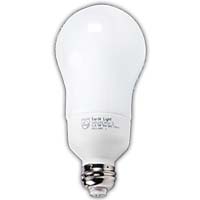
![]() Compact fluorescent
Compact fluorescent
Images courtesy of www.bulbs.com
|
|
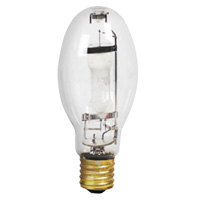
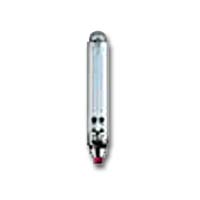
| High intensity discharge (HID) lamps produce
so much light that they are generally used to light arenas and parking lots. Since they
use ballasts and work by generating an electric arc, it takes a few seconds for the lamps
to light and requires special fixtures. Low-pressure
sodium lamps are the most efficient artificial lighting, have the longest service life,
and maintain their light output better than any other lamp type. However, because of the
absence of blue and green frequencies in sodium's emission spectrum, an illuminated object
only appears in shades of yellow or gray whenever this type of lighting is used.
High-pressure sodium fixtures should be used in outdoor
settings since they give the same amount of light for 1/6 the energy of incandescent bulbs
(yellow/white, 24,000 hours). Mercury vapor lights (blue/violet, 24,000 hours) and low
pressure sodium lights (yellow, 18,000 hours) are shown below.
|
|
|
|