Current
Utilization of Solar Energy in Buildings
Many methods of solar energy are being
used in municipal and commercial building projects. Among them are: building integrated
photovoltaic technologies (BIVP), passive solar heating, and the use of less
(or more) energy-absorbent materials in construction. These techniques are used to lower
energy demand, increase efficiency, and economically satisfy corporate needs by
lowering annual cost. The initial expense is recovered and evolves into a surplus
after just a few years, creating an initiative for new commercial buildings to integrate
these designs.
Photovoltaic cells are also commonly
being implemented in modern architecture. UNI-SOLAR® products
consist of spectrum-splitting cells which are constructed of three separate amorphous
semiconductor solar sub-cells. Each of these subcells has different spectral
response characteristics that allow the cell to convert the different visible and near
infrared wavelengths of sunlight with optimal efficiency. BP Solar's Millennia modules have
no discrete parts or mechanical connections between the cells to break or come apart.
Their tandem junction structure uses two different types of semiconductors to capture
different portions of the light spectrum, increasing the efficiency and producing a
monolithic circuit of solar cells formed directly on the glass superstrate. Photovoltaics
are good because their peak output is during midday when the demand for cooling is
comparably high. Since PV cells only produce DC current, an inverter is required to create
AC electrical output.
A suitably sized solar electric system
will charge batteries or export electricity to the grid during the day and use grid or
battery power at night. In Central Florida the average residential consumer uses 11,100
kwh/year or 30 kwh/day. If a 1000 watt peak solar system was installed on a roof, it would
produce electricity at a rate of 1720 kwh/year with an average daily insolation, or
equivalent sun hours, of 4.65 hours per day. Such a system would
cost $24 per month and eliminate 3,818 lbs. of CO2, 15 lbs. of SO2,
and 8 lbs. of NOx emissions in the first year. Over the course of the year a
grid-tied system can be a net exporter of electricity.
The “Whole-Building Approach”
to architecture represents a design that implements efficient practices to the fullest. It
begins with the use of energy-efficient schematics and applies solar energy
techniques to provide heat or electricity. Passive solar and photovoltaic methods are
applied to maximize energy production. This focus on the entire building is to specialize
every aspect of regular architecture into an energy making or saving device.
Research at the National Renewable Energy
Laboratory (NREL) has been conducted to find ways to put solar technology to work in
whole-building designs. NREL’s High-Performance Building Research (HBPR) web-site showcases nine commercial
projects that involve various aspects of solar technology. Their premier project, the Mt.
Zion National Park Visitor’s Center in Springdale, Utah, uses a roof-mounted
photovoltaic system alongside efficient floor, wall, and roofing materials to reduce
energy cost and demand. The Visitor's Center also utilizes cooling towers. These towers remove heat
from the interior air. At the top of the tower, water is circulated over pads that absorb
heat from the surrounding air, thereby cooling the air through evaporation. Computers then
direct the cooler, denser air back into the building, thus lowering the energy demand
required for climate control.
A very simple, widely-used method that
has been discovered to save cooling costs is switching the color of roofs in buildings to
white instead of black. Based on testing performed at the FSEC's Flexible Roof Facility last summer,
it was discovered that white tile provides the best cooling related performance compared
to other options, saving almost 19% of the average cooling costs. In addition, the Energy
Efficiency and Renewable Energy Network (EREN,) a branch of the U.S. Department of Energy,
has also concluded the positive effects of lighter-colored (preferably white) tile
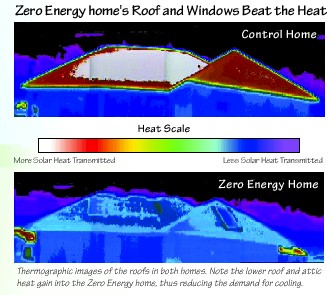
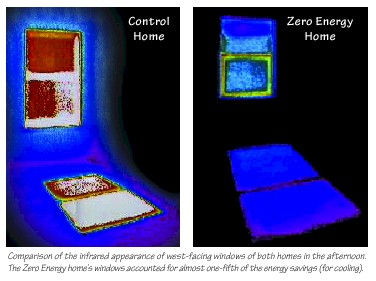
roofing. The site showcases two project homes: one home with standard features and average
energy savings; the other home, known as the "Zero Energy Home," which
displays many key features of an extremely efficient solar technology-based building.
While both having identical attics, they differ in the type and color of the roof
material, and in return, energy efficiency. The control home attic reached temperatures of
138 degrees Fahrenheit, while the experimental home reached no higher than 100 degrees,
just above the surrounding outside temperature. This feature saves significantly on
controlled cooling costs, thus reducing energy use.
Images courtesy of the Energy Efficiency and Renewable Energy
Network
Another passive solar implementation used
in a whole building approach is the use of trombe walls. Trombe walls are made
of windows and a black coating that trap heat from the sun in between them. The heat is
then released slowly through a thermal mass such as masonry or water-filled walls. These
methods are used at the NREL Visitor Center (The Dan Schaefer Federal Building) and also
at the Zion National Park Visitor Center. A key use of current solar use is
preheating air before it is used internally. This is achieved by erecting a black piece of
perforated sheet metal nest to a wall and building fans next to it to blow air against the
hot metal. This reduces cost of heating by 10 to 30 dollars per square meter annually and
requires no maintenance. A final method of utilizing solar energy is the use of
solar thermal energy to directly heat a liquid that will then carry the heat elsewhere.
This energy can be used for heating water in homes and buildings and is dramatically
cheaper than heating with electricity or natural gas. |