PV
Awning
Our product is an awning whose top surface
is covered with a MillenniaTM (BP Solar) module. The awning is adjustable and
provides shade to an adjacent opening in the building, such as a window or balcony, during
summer while allowing the majority of the sunlight's radiant energy to reach the same area
during the winter. Most existing awnings are either cloth canopies that
absorb light or metal awnings that reflect light. In contrast to
these, our proposed awning integrates into the power grid
of the building, supplying electricity to offset the building's energy
needs.
Our product will
perform at its highest efficiency when used on south-facing windows.
In the summer, it will also serve as a shade above the window to
block unwanted heat from entering the building, resulting in a
reduction of cooling costs. During the winter when the sun is closer
to the horizon, it will still allow sunlight to enter and heat the
building.
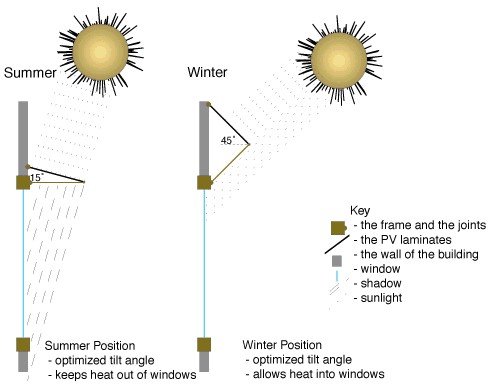
used with the permission of the artist
Justin Anderson
BP Solar's standard MST-43 Millennia module measures
48-3/8" by 26-1/4" x 2" and would adequately span a typical 3' x 5' or 4' x
5' window. When mounted onto an aluminum support frame to provide a 15 degree tilt during
summer, the shadow would cover the 4' span as well a cast an 8' shadow along the wall,
well beyond a window's 5' height. In the diagram shown
above, the tilt angles (15 and 45 degrees) are for a building located at 30
degrees latitude. In general, the awning's tilt angles for other latitudes
are: the latitude +/- 15 degrees.
Ideally, the awning would only need to be adjusted two times a year at the equinoxes.
For our product, we
chose to use a standard framed module to simplify the awning's support structure.
On a real building, designers would probably want
to use unframed laminates and build their own aesthetically
appealing framing system to hide unattractive support members.
Each of these modules, one per individual window awning,
would provide approximately 71 volts and 43 watts. Incorporating the electricity produced by the PV system
into the building requires converting its DC voltage to AC
voltage. This is done using an inverter. The size and type of inverter chosen is based on
the specific installation. Some configurations require an isolation transformer
to tie the system into the service
entrance of the building, blocking DC voltage from entering the grid.
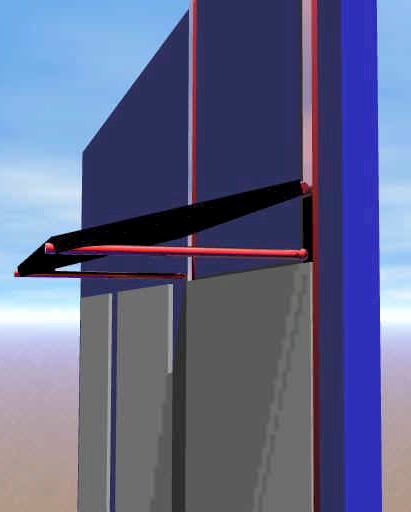
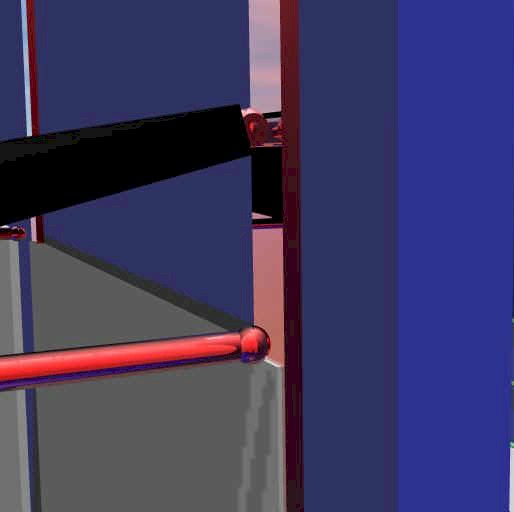
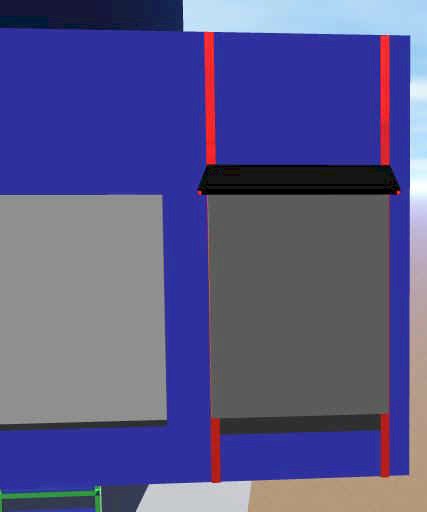
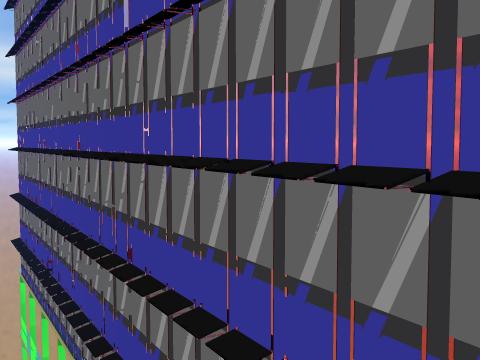
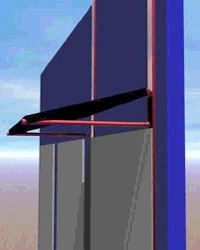
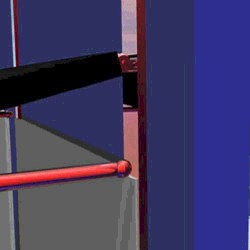
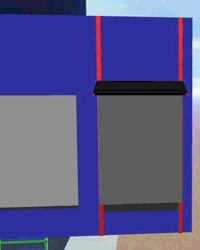
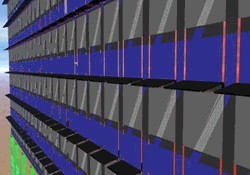
In these images, the awnings
are the slanted black planes, the building is blue, the windows are gray, and the
supporting aluminum channels and rods are red. these images are used
with the permission of the artist, Justin Anderson.
|
|
This side view is of a single window awning. The red beams along the building are aluminum channels that support the awning and permit it to be to be titled. |
|
|
This close up view of
an awning shows the rollers on the back of the module and the tie rods
which slide within the aluminum channels,
allowing the panel's tilt to be adjusted. |
|
|
|
|
|
|
During the
summer when the sun is at high noon, the awning's shadow will
shade
the window protecting it from
the sun's direct rays while producing
electricity for the building. |
|
|
The 245 awnings on
this building's South facade would create an array with a peak
rating of 10 kilowatt. |
|
As the sun's altitude changes throughout the day, only certain
parts of the window would be shaded. If instead BP Solar's IntegraSystemTM
framed modules (as opposed to single-framed modules) were to be
used, their bolted, overlapping flanges would keep the windows
completely shaded
throughout the day during the summer, not just when the sun was at high noon.
|
|