Fossil
Fuel Crisis
Consumption of fossil fuels is occurring
at an alarming rate, with devastating effects to our environment. The excessive use of
fossil fuels increases acid rain and creates a dependence on limited resources. Currently,
the method used to obtain fossil fuels for public consumption is to either drill holes
into the earth or excavate mines. Oil is used for many products such as gas for cars, petroleum
for plastics, facial creams, and most importantly electrical energy. Since these demands
are becoming a burden to uphold, their usage should be drastically reduced.
Supply
 |
|
Demand
 |
|
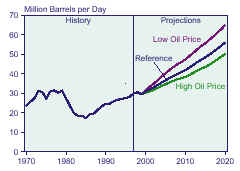
The supply graph seen
above shows that the supply for oil could increase to 65 million barrels per day over the
next twenty years. This predicts that there will be more oil available. However, there
will not be enough oil for our needs. Demand (as we can
see from the second graph) will increase to a total of about 113 million barrels per day,
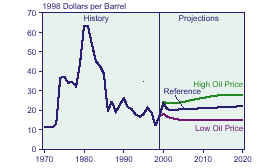
which is about twice as much of the projected supply. As a result, oil prices will
increase from $25.00 to $30.00 per barrel. This means that after the year 2020, consumers
will spend about 1.238 trillion dollars per year. |
Price
 |
Lines 31-38 from an accompanying
table by the Energy Information
Administration give the production totals in thousands of barrels per day and show the
rate at which fossil fuels were being consumed in the United States during November 2000. |
Health Related
Problems
The non-renewable energy sources,
primarily fossil fuels, affect the environment in damaging ways. The worst of these is air
pollution caused by the waste products of burning fossil fuels. In 1994, for example, the
United States produced more than 90% of the world-related emissions of sulfur dioxide,
carbon monoxide, and nitrogen oxides. The abundance of these particles in the lower
atmosphere, especially nitrogen oxide particles, produces ozone. Ozone in the stratosphere
protects life from ultraviolet and extreme ultraviolet radiation. Ozone in the atmospheric
level where we breathe had been proven to destroy living tissue, especially lung and
airway tissue when breathed for an extended amount of time. Also it has been proven since
the 1970s that populations in high ozone areas will have an increase in
asthma attacks.
Moreover, the sulfur dioxide and the
nitrogen oxides themselves have harmful effects on those of ozone. The direct consumption
of coal and oil, and the degree of their presence in the air has caused increased
mortality rates in the surrounding areas. Early adult death is 26% higher in locations
with high concentrations than in the lower concentration areas away from the power plants.
The increase for the risk of cardiopulmonary disease has been shown to be 37% overall, and
as high as 57% among select groups (in this case, women who had never smoked). Sulfur
dioxide, even at low concentrations can bring on an increased incidence of asthma attacks.
Levels of nitrogen oxides correlate with an increase in cases of respiratory track
infections. Approximately 90% of sulfur and 95% of nitrogen emissions, both fundamental in
causing acid rain, arise from the use of coal in the production of electricity, base-metal
smelting and from combustion in vehicles. Fossil fuels, especially those of coal and oil,
cause increased production of carbon dioxide in the atmosphere and are responsible for
global warming. This has a negative effect on the entire planet’s ecosystem and not
just people. The burning of fossil fuels has a detrimental effect on humans in general and
it becomes more damaging as you get closer
to the power plants themselves.
Oil and other carbon-based fuels are
non-renewable and the world is starting to take measures to reduce dependence on them.
Alternatives include hydroelectric, solar, geothermal, tidal power, and wind. Methods of
converting geothermal or tidal energy into electricity thus far have shown little promise.
The damming of rivers and lakes for hydroelectric power raises other environmental concerns
and there are few areas where there is enough wind to make wind power a reasonable option. |