Relief Agencies

The American Red Cross was founded on May 21, 1881 by Clara Barton. Starting in 1905, it runs under a Congressional charter and as an "instrument of the government" it is charged with carrying out the duties and responsibilities of the Geneva Convention. It's 50-member board of Governors is directed by the President of the Red Cross and makes decisions which are relayed through instructions to the directors of the 769 regional or city-based chapters. The Red Cross has an annual budget of $4.1 billion which is distributed at the national level and then to individual chapters.
Red Cross chapters assist disaster areas based on three basic missions: food and water, shelter, or medical services. The director of each chapter establishes how the services are conducted. Periodically, check-ups of each chapter's activites are relayed to the board of governors.

AT&T has recently spent 500 million dollars on augmenting and improving their Network Disaster Recovery (NDR) organization. AT&T is implementing this by constructing a new NDR Equipment Warehouse in the southeastern part of the USA and by expanding the NDR fleet. This organization quickly and efficiently establishes temporary wireless and wired connections in disaster areas. For example, after a disaster NDR will, as quickly as possible, make temporary repairs to any and all damaged towers and equipment to establish temporary connections until permanent repairs can be made. NDR response teams can use such recovery equipment as:
- Cellular Network Recovery - This mobile equipment re-establishes a cell site until the damaged site can be repaired,
- Lightwave - Lightwave trailers convert electronic signals to optical signals for transmission over AT&T's fiber optic, lightguide network, and
- Portable Radio Towers -A temporary radio tower would establish microwave repeater or terminal sites when cable can not be used.

The Federal Emergency Managment Agency, FEMA, is a government agency composed of 10 operational regions. In 2003 FEMA became part of the Department of Homeland Security. FEMA responds to forest fires, earthquakes, tornadoes, hurricanes, tsunami, and chemical spills to help with clean up and attempt to preserve life.
When a disaster occurs it is initially catagorized as level 1-5 (1 high level disaster, 5 low level disaster). FEMA then responds accordingly by establishing an incident command base, filling neccesary positions, and creating an incident action plan.

The Strong Angel projects happen post-disaster in an effort to solve and reduce disaster-related consequences with the help of volunteers.
- Strong Angel 1 was held on Hawaii during June 2000 to simulate evacuating the islands of population in the event of extreme lava flows. This was brought on by the Kosovo refugee migration in 1999.
- Strong Angel 2 was also held in Hawaii to try and settle issues that still remained from the first Strong Angel. In this project the problem became clearly defined as "critical information management within austere environments." The work from these projects did help in the post 9/11 tragedy.
- Strong Angel 3 was held in San Diego during August 2006, see album images.. It was designed to test and train disaster responders, technologists, and community leaders for events such as Hurricane Katrina, Hurricane Rita, South Asian Tsunami, and Pakistan Earthquake.
A Complex Contingency: A lethal and highly-contagious virus gradually begins
to spread around the globe. Infection rates are high, deaths are frequent, and no
vaccine is available. Cities all over the world fall under quarantine. Emergency
services and medical centers are stressed and national government agencies, affected
just as severely as the cities themselves, cannot provide assistance. And then the
situation goes from bad to worse. A terrorist cell, having long waited for such
an opportunity, launches a wave of successful cyber attacks in a medium size city
somewhere in the developed world, bringing down grid power, Internet access, land
and cellular telephones. Other, more subtle, attacks follow, and it's difficult
to sort out the mess.
Unlike the other Strong Angel projects, a scenario similar to what they were testing had yet to occur. They have increased and improved communication systems and technology to enhance the efficiency during a disaster scene. For example, they've developed watches that receive information and transmit information people might need, such as "GET DOWN! HERE COMES ANOTHER STORM SURGE!" or other important conditions.
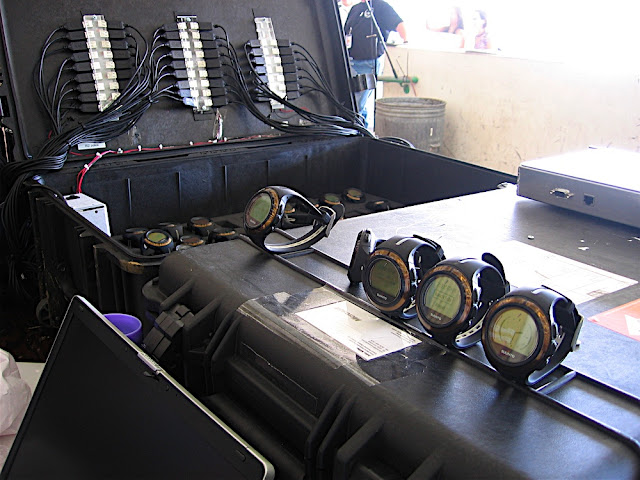
While wearing it they are also traceable from the information center that way everyone's always accounted for. If our system were to go into effect it would most likely first be tested in a Strong Angel project.
About FEMA
http://www.fema.gov/about/index.shtm
AT&A Completes Itegration of Network Disaster Recovery Organization
http://www.reuters.com/article/pressRelease/idUS192145+20-Nov-2008+PRN20081120
AT&A Completes Itegration of Network Disaster Recovery Organization Bedminster, New Jersey, November 20, 2008
http://www.att.com/gen/press-room?pid=4800&cdvn=news&newsarticleid=26331
A Brief History of the American Red Cross
http://www.redcross.org/museum/history/brief.asp
DARPA's Strong Angel II
http://www.cra.org/govaffairs/blog/archives/000121.html
FEMA's Organization Structure
http://www.fema.gov/about/structure.shtm
How the American Red Cross Works
http://people.howstuffworks.com/american-red-cross3.htm
International humanitarian law: the essential rules
http://www.icrc.org/Web/Eng/siteeng0.nsf/html/5ZMEEM
Network Disaster Recovery
http://www.corp.att.com/ndr/
Picasa - Strong Angel III Images
http://picasaweb.google.com/sanjanah/StrongAngelIII#
Recovery Exercise
http://www.corp.att.com/ndr/exercises_2008q4_photos.html
Recovery Equipment
http://www.corp.att.com/ndr/team_equipment.html
Strong Angel
http://vsee.com/photo/StrongAngel/
Strong Angel III
http://www.strongangel3.net/
Strong Angel III Tests Military-Civil Disaster Response
http://www.defenselink.mil/news/newsarticle.aspx?id=567
United States Department of Homeland Security/FEMA
http://www.fema.gov/pdf/about/org_chart.pdf