History of Broadcasting and Telecommunications
Telecommunicating means
any transmission, emission, or reception of signals, writing, images, or other information
by wire, radio, or any other electromagnetic system. Being able to send messages
remotely has been the subject of many technological advances since the easliest
days of the concept.
The telephone was first invented in the 1870s by Alexander Graham Bell and Elisha Gray. They both came up with the idea around the same time and practically raced eachother to the patent office. Later they both entered a long legal battle over the patent and Alexander Graham Bell won. The birthday of the telephone was March 10, 1876, which was also the death of the multiple telegraph. Bell was able to develop the telephone using information about the earlier invention of the telegraph. By October 1874, he was able to inform his father-on-law of a multiple telegraph.
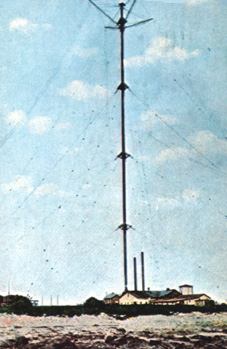
Guglielmo Marconi's earliest radio transmissions, or Hertzian waves, carried dots and dashes in the forms of wireless telegraphy. Reginald Fessenden, a Canadian living in Brant Rock, Massachusetts, created a system, with the support of the National Electric Signaling Company, that had enough power to carry distinguishable audio sounds. His first broadcasts on December 24, 1906, were primarily to shipboard operators of the US Navy and United Fruit Company equipped with the Fessenden apparatus along the Atlantic Coast. The transmissions included sounds of his violin and bible passages. His financial supporters discontinued the project because they thought that it would have little practical use since it was only a one way signal to multiple receivers.
The telephone was first invented in the 1870s by Alexander Graham Bell and Elisha Gray. They both came up with the idea around the same time and practically raced eachother to the patent office. Later they both entered a long legal battle over the patent and Alexander Graham Bell won. The birthday of the telephone was March 10, 1876, which was also the death of the multiple telegraph. Bell was able to develop the telephone using information about the earlier invention of the telegraph. By October 1874, he was able to inform his father-on-law of a multiple telegraph.
Guglielmo Marconi's earliest radio transmissions, or Hertzian waves, carried dots and dashes in the forms of wireless telegraphy. Reginald Fessenden, a Canadian living in Brant Rock, Massachusetts, created a system, with the support of the National Electric Signaling Company, that had enough power to carry distinguishable audio sounds. His first broadcasts on December 24, 1906, were primarily to shipboard operators of the US Navy and United Fruit Company equipped with the Fessenden apparatus along the Atlantic Coast. The transmissions included sounds of his violin and bible passages. His financial supporters discontinued the project because they thought that it would have little practical use since it was only a one way signal to multiple receivers.
 |
 |
| Image courtesy of EWH IEEE | Image courtesy of United States Early Radio History |
| 1909 | In April of 1909 Charles Herrold sent out broadcasts from his Herrold School Electronics Institute in San Jose 10 years before the Department of Commerce began to regulate radio by requiring operators to buy licenses to send out signals. From 1909 until 1916, he was on the air identifying himself as "SJN." During the first world war most stations were not allowed to continue broadcasting. After the war, in 1921 he was granted a commercial broadcast license for KQW which was eventually sold and became KCBS in San Francisco. Herrold also gave us the distinction between the terms broadcasting and narrowcasting based on his father's patented seed spreader. | |
| 1919 | David Sarnoff came out with the "radio music box memo" stating the possibility that the Marconi Wireless Telephone Company could set up radio broadcast services aimed at the general public. Sarnoff later became the 3rd President of the Radio Corporation of America, RCA. Frank Conrad is considered by many to be the father of commercial radio broadcasting at KDKA in East Pittsburgh, Pennsylvania introducing advertising to radio. | |
| 1938 | Alfred J. Gross invented the first walkie-talkie. In 1941 he invented a "two-way air-to-ground communications system" that the United States used in the second World War. This helped communicate with pilots who were currently flying behind enemy lines. The ground and airborne communication device communicated over radio waves. But this whole system wasn't introduced to the public until 1976. Soldiers since World War II, businesses, law enforcement, and emergency services have all been able to benefit from using these 2-way communication devices. | |
| 1954 | Martin Cooper led the development of the invention of the cell phone when he was hired by Motorola. He had worked on developing other portable communication products before like portable, handheld police-radios. On April 3, 1973 Martin Cooper and Motorola took the cell phone to a public demonstration in New York. He made the first cell phone call using the heavy, 30-ounce phone, to his rival at AT&T Bell Labs. | |
| 1957 | Sputnik was launched by the USSR. The United States Department of Defense formed ARPA
(presently named DARPA) to take the lead of militant technology. Many in the Department
of Defense wondered exactly what was being sent by those many beeps being emitted
from this first man-made satellite. This led to widespread panic in the general
population and also those who worked in the newly emerging telecommunications field.
Were we, as a country, vulnerable to a threat from the heavens? With the Nuclear Genie
out of the bottle at this point something must be done to protect our soil an way
of life.
|
|
| 1962 | A man named Paul Baran of a government agency named RAND commenced a study for the United States Air Force to have control over their missiles and bombers (this way in case of a nuclear attack the Uunited States could still have command over their retaliative nuclear vessels). This birthed the idea of "packet switching". This idea was one in which information could be taken into the form of a "package" then be sent to another computer, reorganized in the correct sequence and in the case of information being lost it could be resent. | |
| 1969 | While NASA had its eye and feet on the moon, Paul and his three other acquaintances put ARPANET into action with a mini computer (which served as a base for the switch) linked to four nodes. | |
| 1971 | Ray Tomlinson developed a way of copying files called CPYNET over the network to his employees He then made e-mail compatible with ARPANET released in 1972. He is the creator of the @ symbol to link user name and address. FTP allowed file transfers between Internet sites. Ethernet (for local networks) was Bob Metcalfe's idea which he at the time claimed to be "packet networks. Harvard rejected this thought until further elaboration was provided through equations. | |
| 1972 | ARPENET started using Network Control Protocol (NCP). | |
| 1980 | The 70's invention of TCP(IP) was officially excepted by the Defense Department. | |
| 1983 | IP universally replaced NCP and is still used today. | |
| 1989 | DSL, digital subscriber line - a modem specifier, was invented with the stimulus of video in mind. It had a preferred faster download rate which was needed to run video streams. The wired-down DSL concept was soon replaced by the wireless internet known as WiFi. WiFi uses a router box that plugs into a phone outlet. This, ironically enough like radios, uses radio waves to send transmitions between your computer and the device. These devices relay back to wires that we see everyday in the ground and in the air. Besides radio waves for short game there is a subsequently large cable across the Atlantic Ocean which was complete in 1866 to send instant telegraphs across the sea. There were many inventors that picked up on the idea of e-mail once there was the chance for information to be shared on multiple windows from multiple terminals. | |
| 1990 | Tim Berners-Lee and his companions at the European Laboratory for Particle Physics (CERN) made up a new system for information distribution which by 1991 became the world wide web. | |
| 1991 | The University of Minnesota decided they wanted a more user friendly interface for searching of files of the college's local network for their students. | |
| 1994 | MIT's school for computer technology raised fears of different necessary software for different Internet methods. This fear in mind, they requested that Tim's system of hyper texting be set as the standard for Internet protocol. | |
| 1995 | The limit of commercial business on the Internet was abolished when the National Science Foundation discontinued their support of the Internet's backbone (NSFNet ) | |
| 1998 | The Internet was initially funded by the government, therefore its uses could only be used for intentions of research and education. These rules took a major turn for the better in 1998 when Windows 98 came out and made Bill Gates dream of the Internet becoming a commercially-based reality. |

Google - Definitions of telecommunications
http://www.google.com/search?hl=en&defl=en&q=define:telecommunication&ei=ChCaSdyyDdLjtgfG6YiZCw&sa=X&oi=glossary_definition&ct=title
About.com - The History of the Telephone - Alexander Graham Bell
http://inventors.about.com/od/bstartinventors/a/telephone.htm
Nobelprize.org - Giglielmo Marconi
http://nobelprize.org/nobel_prizes/physics/laureates/1909/marconi-bio.html
GMFE 2009 - Giglielmo Marconi
http://www.consorziofia.it/gmfe/gb/marconi.html
About.com - Reginald Fessenden (1866-1931)
http://inventors.about.com/library/inventors/blfessenden.htm
Wireless Telephony and the High-Frequency Alternator
http://earlyradiohistory.us/1940fes2.htm
Inventing the Wireless Telephone and the Future
http://ewh.ieee.org/reg/7/millennium/radio/radio_wireless.html
Experiments and Results in Wireless Telephony
http://earlyradiohistory.us/1907fes.htm#adapted
Broadcasting's Forgotten Father: The Charles Herrold Story
http://www.antiqueradios.com/chrs/journal/herrold.html
What Was the First U. S. Radio Station?
http://jeff560.tripod.com/first.html
NationMaster - Charles Herrold
http://www.nationmaster.com/encyclopedia/Charles-Herrold
The Canadian Journalism Project - Charles Herrold: Inventor of Radio Broadcasting
http://jsource.ca/english_new/detail.php?id=98
New World Encyclopedia - Broadcasting
http://www.newworldencyclopedia.org/entry/Broadcasting#United_States
Radio Music Box Memo (1916/1920)
http://earlyradiohistory.us/1916rmb.htm
United States Early Radio History - Lee DeForest
http://earlyradiohistory.us/sec011.htm
MBC - Sarnoff, David
http://www.museum.tv/archives/etv/S/htmlS/sarnoffdavi/sarnoffdavi.htm
IEEE - Frank Conrad, 1874-1941
http://www.ieee.org/web/aboutus/history_center/biography/conrad.html
Access my Library - Radio
http://www.accessmylibrary.com/coms2/summary_0193-11332_ITM
Parxy.com - History of Walkie Talkies
http://www.parxy.com/history-walkie-talkies.html
TheHistoryOf.net - The History of Cell Phones - A Vision Realized
http://www.thehistoryof.net/history-of-cell-phones.html
World Space Week Boulder!
http://www.colorado.edu/StudentGroups/CUSEDS/Events/WSW/2007/WSW2007.htm
Sputnik the fiftieth anniversity - sputnik and The Dawn of the Space Age
http://history.nasa.gov/sputnik/
The History of the Internet
http://www.davesite.com/webstation/net-history.shtml
A Brief History of the Internet
URLhttp://www.walthowe.com/navnet/history.html
Email History
http://www.livinginternet.com/e/ei.htm
About.com - Inventors Modems
http://inventors.about.com/library/inventors/blmodem.htm