Bernoullian lift and Newtonian lift
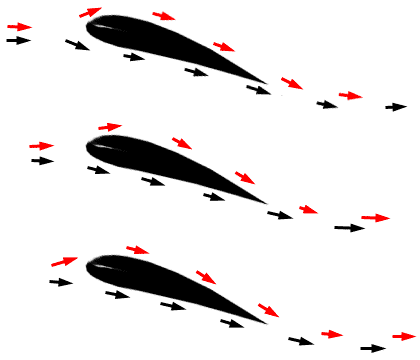
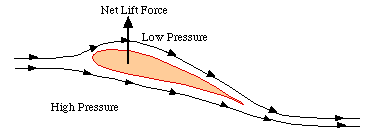
Bernoullian lift: Air "splits" at the front of a wing, and recombines at the rear of it. Because the air recombines, if the top of a wing is longer than the bottom, air travels faster over the top of a wing than over the bottom (this is referred to as the "principle of equal transit times"). According to the Bernoulli effect, the quicker the air is moving, the lower the pressure. This means that there is lower pressure on the top than the bottom. This causes air on the bottom to try to move upward, pushing the wing upward with it.
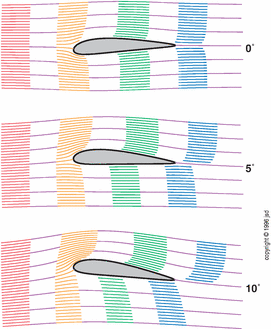 True airflow over a wing given
differing angles of attack
Image courtesy of See How It Flys
Newtonian lift: The angle of attack pushes the air downward. This causes the air to leave the wing with more downward velocity than it started with. Since there needs to be an upward movement to counteract this downward movement, the wing creates lift (Newton's 3rd law).
If we consolidate these two theories, the resulting idea would look something like this: Air moves faster over the top of the wing than over the bottom. This causes a near 'vacuum' over the top of the wing. Air from the bottom of the wing tries to go upward pushing the wing upward. This so far is standard Bernoullian lift. However, air on the top of the Bernoullian vacuum is also moving downward into the vacuum. An effect known as the Coanda Effect assists this. The Coanda Effect is a property of the viscosity of fluids in which a fluid tends to "stick" to an object.
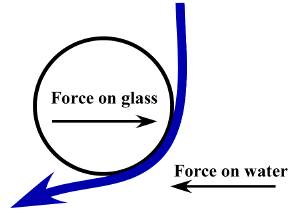
At the rear of the wing, due to the Coanda Effect, the air attempts to follow the curvature of the wing downward, resulting in a net downward momentum change in the air. Also, at the front of the wing, the air is forced to separate and the air below the wing transfers its upward momentum to the wing. The unbalanced momentum is transferred into the wing creating lift.
Take a moment and investigate your instincts about good wing design with this wind tunnel animation from NASA.
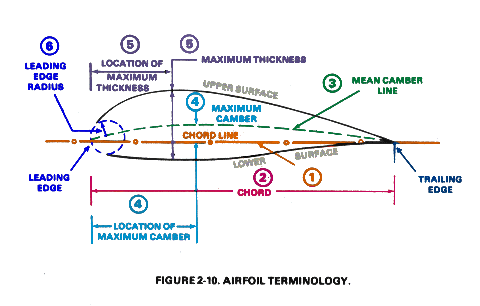
Listed below is a glossary of commonly used words for discussing the application of airfoils and their effects.
Wing Span - the distance from one tip of the wing to the other tip on the other side.
Chord - the distance from the leading edge to the trailing edge of the wing
Camber - the ratio of curvature to cord length
Mean Camber Line - an imaginary line that runs half way between the top and bottom surfaces of the airfoil
Angle of attack - an imaginary line that runs through the fuselage and parallel to the chord
Rudder - controls the yaw
Yaw - the horizontal movement, "the left and right direction" of an airplane
Elevator - controls the pitch at the tail
Pitch - the vertical movement, "the rise and fall" of an airplane.
Aileron - controls the surfaces on the trailing edge of the wing

Roll - to turn horizontally, to twist
Winglets - a piece that can be flipped up at the end of each wing to help reduce drag
Induced drag - the drag due to the production of Lift
Parasitic drag - the drag that is produced from the resistance of the air that moves across the wing
Cantilever - a wing design that is used on small aircraft, wing that is top mounted and is supported by struts
Science Hobbyist
http://www.eskimo.com/~billb/wing/airfoil.html
See How It Flys
http://www.monmouth.com/~jsd/fly/how/htm/airfoils.html
University of Washington
http://www.aa.washington.edu/faculty/eberhardt/lift.htm
All Star Helicopters
http://www.cybercom.net/~copters/aero/airfoils.html
East Kentucky University
http://www.biology.eku.edu/RITCHISO/554notes2.html
Encarta
http://encarta.msn.com/encnet/refpages/RefMedia.aspx?refid=461516765
NASA
http://www.grc.nasa.gov/WWW/K-12/airplane/foil2.html