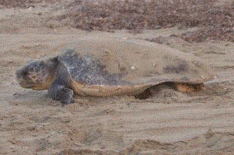
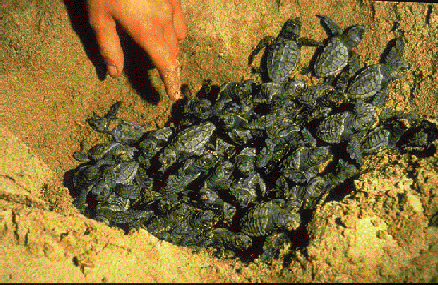
Sea turtles are protected under the Federal Endangered Species Act, which states that no person, firm, or corporation may kill, disturb, mutilate, harass or destroy any marine turtle. The four types of turtles that nest along Volusia County beaches are the Loggerhead, Leatherback, Kemp's-Ridley, and Green turtle. I n 1997, 346 nests were observed, from which 298 produced hatchlings. Of these, over 2,500 hatchlings from 51 different nests were disoriented, and 100 hatchlings were found dead. In 1998, there were 538 nests, from which 444 produced hatchlings. Of these, about 1,600 hatchlings from only 33 nests were disoriented, and only 68 hatchlings were found dead.Duhring, Karen-January 11, 1999 The Loggerhead is the most common sea turtle that uses Volusia County as an area for nesting. Florida is the second most important nesting area in the world for Loggerhead sea turtles. Sea Turtle Conservation Program
Mother Turtles Mother turtles nest between May and August. During this time, they may become disoriented because of the light on the beaches. Because of their nocturnal nesting tendencies, the nesting female turtles avoid the beach when they see the lights coming from the shore. The bright lights from the beach give the nesting turtles the impression that it is daylight. Sometimes, turtles will come on-shore and abandon the nesting process or just release their eggs into the sea. The lights on the beach that attract hatchlings repel the parents. By eliminating these lights we could solve both problems. Research in the United States and in Costa Rica has found that a turtle's sensitivity to illuminations is dependent on the wavelength of light. White mercury vapor lamps emitting short-wave light have been shown to significantly reduce the number of nesting females, while yellow low pressure sodium vapor lamps emitting long-wave light had no effect. The widespread adoption of this type of lighting in areas where illumination is essential would significantly reduce disturbance to turtles. Hatchlings Hatchlings emerge during the summer months, from July through October. Incandescent light bulbs attract turtles from the beach despite the turtles' normal tendencies to orient toward the sea. In response to violations of state and federal laws and city ordiances, our group has dedicated its efforts to preventing further interference with turtles and their environment. Turtles are able to orient towards the sea using a method that is called phototropotaxis. First, they direct themselves towards the brightest region. Next, they balance the levels of light so that it equals the amount of light that strikes both eyes. Most species of turtle hatchlings are strongly attracted to the range of 400-640nm. The Loggerhead turtles that nest in Florida are also attracted to a special frequency of red light near 700nm. Light meters can be designed to use a cone of acceptance (a type of receptor that only allows light in a certain range to enter and measure only certain wavelengths) to determine harmful light and give violators of turtle safety laws a citation.
According to some scientists, the hatchlings have light intensity comparators, which give them a way to compare different intensities of light from different directions. This allows them to orient themselves in the brightest direction. Turtles have rods and cones in their eyes that allow them to see a wide variety of light. However, they, unlike humans, can distinguish the different frequencies that enter into their eyes, rather than combine it into the color vision that humans see. In addition to intensity and wavelength, turtles also depend on light, shape, and direction. Most turtles will turn away from areas where there are stripes of light and dark and head toward uniformly lighted areas even when these stripes are extremely bright. They also prefer constant light rather than a flashing one. Turtles also show a tendency to orient themselves toward silhouetted objects. Most turtles show a tendency to ignore lights that are not close to the horizon, where the moon would normally be. Although turtles can find the sea without the light of the moon, they have a higher success rate when the moon is brighter. Since turtles can use the moon to orient themselves, they ignore light that is above the altitude where the moon would be (10-30 degrees above a turtles line of sight). Some lights that would be attractive to turtles become less attractive when paired with a bright yellow light. Although it is true that turtles avoid yellow light, they are able to differentiate between light waves of different frequencies that enter the eye at the same time. For instance, when two lights shine at 525nm and 645nm the source would be highly attractive to hatchlings, even though this light appears yellow to people. If there was a yellow monochromatic light, however, that shined at 588nm, it would appear only relatively attractive to turtles. Even though many people consider low pressure sodium lights dangerous because they make it difficult to see at night, it seems that these lights, that emit yellow light, are the least distracting to turtles. |