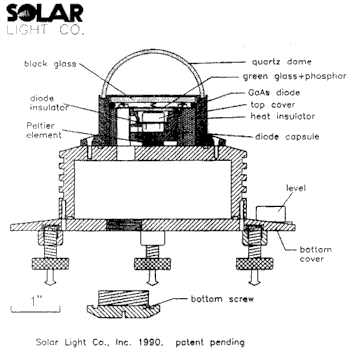
A light meter measures two different aspects of light, quantity and quality. Basically, a light meter consists of a photocell made of cadmium sulfide or gallium arsenide. The cell, which is attached to a battery, resists the flow of electric current by an amount that depends on the brightness of the light. When brighter light falls on the cell, the resistance decreases, allowing more current to flow, producing a larger reading on the meter. In the illustration shown below, an interference filter could be installed near the location of the phosphor.
Quantity and quality are important because we are interested in both the intensity and the color of the light being measured. The concern with brightness is that up to a certain minimum intensity, turtles ignore any artificial light source. The reason that color is important is that people don't want a completely dark beach. So if certain wavelengths of light can be used that do not distract turtles, people can then use these frequencies for minimal required lighting. If the distracting wavelengths of light can be detected, then people can eliminate the distracting lights. If necessary non-distracting lights can be placed in areas minimally visible from the beach. Elaboration of terms Quantity and Quality Quantity is the measure of the amount of light in a given area. Irradiance, or the radiant flux density (intensity), from a bulb is measured in watts/m2, and falls off according to an inverse square law. If you are twice as far away from a uniform point source, the light it provides is one-fourth as strong at the more distant location. To compensate for our eye's reception of light intensity, a unit called a lumen is introduced. A lumen is the quantity of light of ANY frequency that is equivalent to a quantity of light of wavelength 555nm having a radiant flux of 1/683 watts/m2. When light strikes a surface, it illuminates the surface. The two most common units to measure illumination are the American unit, footcandles, and the metric unit, LUX, or lumen/m2. A footcandle is defined as "a unit of illuminance on a surface that is everywhere (spherical) 1 foot from a point source of 1 candle." A LUX, or 1 lumen per square meter, is equal to 0.0929 footcandles. Since most lights are not isotropic, there is a need to describe the intensity of light sources in a specific direction, without requiring the knowledge of the detector's exact distance from the source. This requires the introduction of a solid angle measure, a steradian. One steradian represents the size of a solid angle when the intercepted surface area equals the square of the radius. The term luminous intensity refers to the ratio lumen per steradian and is called a candela. The term that refers to the amount of flux (lumens) per unit solid angle (steradian) and is INDEPENDENT of distance. The other measure of light is the quality, or the color. Color temperature is measured in the Kelvin scale. One candela is also defined as being equal to 1/60 of the luminous intensity per square centimeter of a blackbody radiating at the temperature of 2,046 degrees Kelvin. A spotmeter is a meter that takes a reading from only a very small and select area. It is pointed at an area and usually has a viewfinder that shows where the reading is being taken from. Glossary Resources:
|