Component #3
Product
Our product is a variation of existing light meter technology,
incorporating various enhancements designed to mimic the vision characteristics of sea
turtles. In addition to noting the general levels of visible light, it will have
special sensors to record intensities of those wavelengths that are most distracting to
loggerhead hatchlings, 525nm, 645nm as well as UV-A waves. A different set of sensors
could be installed for use in monitoring the lighting conditions for any sea turtle
species. Also incorporated into the meter will be an adjustable aperture (opening)
which will enable the user to modify the meter's field of detection. This will allow for
both wide area and pin-point detection of problem lighting.
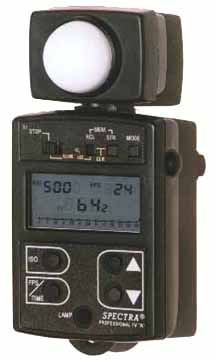
One existing meter combination that could meet the guidelines stated above is the Spectra
Professional IV-A. It is a photographic light meter capable of measuring light
intensities in both footcandles and LUX. It has accuracy of almost a million to
one. This meter also has a multiple channel memory that enables a stored reading to
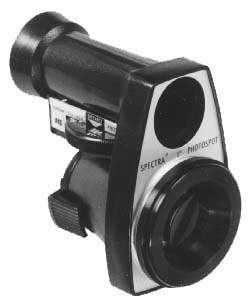
be recalled. In addition to this, the Spectra One Degree PhotoSpot is capable of
turning the Spectra Professional IV-A into a spotmeter,
which will allow for pin-point detecting of problem lights. This combination of
products is one of the possibilities for our product development.
Spectra Cine, Inc.
|
Photos courtesy of Spectra Cine |
Another exisiting meter is the VLX-3W. It is a UV light meter. It is capable
of detecting ultraviolet wavelengths that are also capable of distracting sea turtles, and
leading them away from the ocean. Its detection range is from 0-350mW/cm2 with
accuracy within (+,-) 0.2% of the reading. By combining features from both this
meter and the Spectra Professional IV-A, a product capable of detecting both the visible
and UV light sources that distract and disorient turtles from the ocean could be produced.
TECHNIKA
|
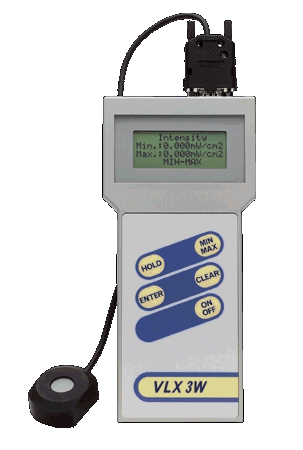
Photo courtesy of Friends in Photography
|
A US patented product that could be modified to perform the job that has been assigned to
our product is the PMA 2100 Radiometer. It is a meter which can be supplemented with
many different detectors, thereby making it capable of giving us readings for the
different range of lights that are distracting to sea turtles. Modifications that
will need to be made to this meter are (1) a means of enabling it to "zoom
in" on problem lights as well as gather light from a wider field of vision and (2)
software that will allow a user to take measurements with both time/date stamps as well as
GPS positional data, store that data, and then transfer the data to a PC. That information
could then be graphically analyzed in two ways:
(1) to profile a specific GPS position and
(2) to display wide area conditions over an extended period of time allowing for a
determination of the effects of how constant artifical lighting sources are perceived
under various moon phases.
Solar Light Company
|
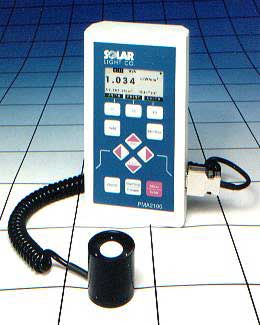
Photo courtesy of Solar Light Inc.
|
United States patent number 5790432 has been indentified as being
fundamental to our light meter's design. It was issued on August 4, 1998 to
Marian Morys of Solar Light Incorporated. Because our product must be capable of
adapting to the different light sensitivities of each sea turtle species as well as
possessing the ability to measure and record light measurements for future reference in
the field, we feel that this patent represents a technology useful to us.
United States Patent Database
This light meter could be produced by Solar Light Inc., a manufacturer of
commercial light meters and related technology. The light meter is targeted at hotel
owners and beachside residents interested in knowing if they are in compliance with local
lighting ordinances as well as government inspectors monitoring lighting ordinances.
Unit prices are projected to be about $4,000 with sales likely to reach several
hundred.
Product Review
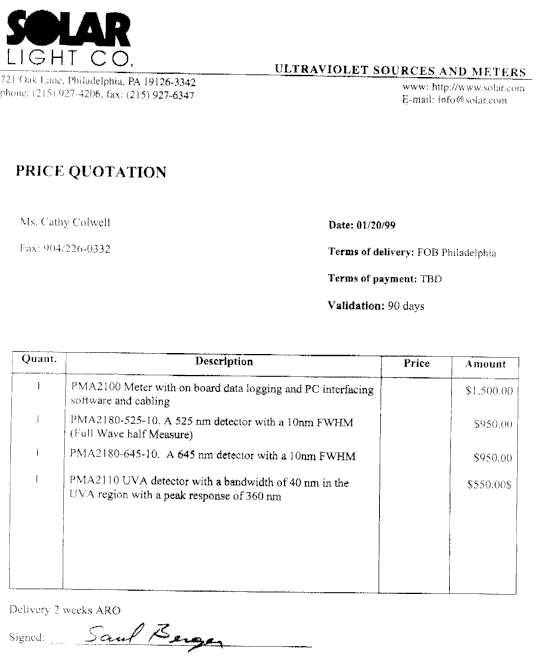
The PMA 2100 meter and host of detectors can provide the instrumentation required. The
PMA 2180 customized detector can be built to monitor 525 nm and 645 nm with a 10 nm
bandwidth. The PMA 2110 detector monitors UV-A with a bandwidth of 40 nm from 340 to
380 nm. The PMA 2100 meter offers data logging and PC interface options. A 10 or 30
degree view angle can be installed into the detectors to match the Loggerheads' acceptance
cone and the detector.
Fax-January 20, 1999
back to top |