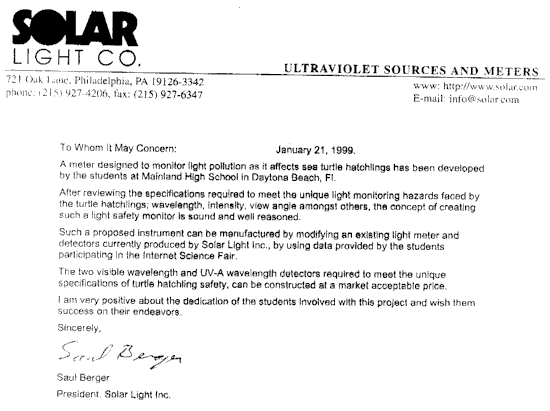
After determining that lighting and its effect on sea turtles represented a reasonable topic for this project, our first step was to establish previous research that has been conducted in the field. Many studies were found whose goals were to determine the effects of lighting on sea turtle populations. However, it was also found that technology was insufficient to quantitatively measure such effects. This led to our interest in developing an enhanced light meter in order to solve the problem. It then became necessary to identify educational opportunites related to our field of study. The University of Charleston, SC, and the Rensselaer Polytechnic Institue of Troy, NY, were found to offer leading programs in marine biology and lighting, respectively. Our proposed graduate program would focus on these two fields of study and offer the knowledge base necessary to pursue a career as a lighting engineer with emphasis on environmental concerns. Finally, as a result of our research, we were able to propose a light meter tailored to the specific application of sea turtles. It offers three enhancements:
This product, aimed at county officials, hotel/condominium owners and beachside residents, will offer the ability to determine if a location is in compliance with local lighting ordinances. It will also present new opportunities for scientists to quantitatively study problems associated with beachside lighting and its effect on sea turtles. Specifically, the meter will allow for the collection of baseline data to be used at other beachside locations.
|