The Oceans
Ocean Currents
Ocean currents are an organized flow transporting water and its contents from one
region of the oceans to another. Though currents are affected by the wind, other
factors also govern current strength and direction; depth, temperature and salinity
are contributing factors to current characteristics.
Global currents are interconnected in what is referred to as "The Global Conveyer Belt." This current system carries warm water towards the poles by surface currents while transporting cold water towards the equator by deep water currents. It is driven by the density gradients in the ocean due to variations in temperature and salinity, slowly conveying water through the world's oceans.
Surface currents are dominated by two main factors: wind velocity and the Coriolis Effect. Winds accelerate fluid particles on the surface by imparting momentum to the fluid through surface stresses. While in the beginning the particles will move in the direction of the wind, over time, the currents are deflected to the right in the northern hemisphere and to the left in the southern hemisphere by the earth's rotation. These predictable rhythms to the currents of the oceans result in the formation of gyres. Notice in the following diagram that the Indian Ocean gyre, the South Pacific gyre, and the South Atlantic gyre all rotate counterclockwise; while the North Atlantic gyre and the Central Pacific gyre rotate clockwise.
In an email dated February 28, 2010, Norton Smith describes the Coriolis Effect.
Global currents are interconnected in what is referred to as "The Global Conveyer Belt." This current system carries warm water towards the poles by surface currents while transporting cold water towards the equator by deep water currents. It is driven by the density gradients in the ocean due to variations in temperature and salinity, slowly conveying water through the world's oceans.

Surface currents are dominated by two main factors: wind velocity and the Coriolis Effect. Winds accelerate fluid particles on the surface by imparting momentum to the fluid through surface stresses. While in the beginning the particles will move in the direction of the wind, over time, the currents are deflected to the right in the northern hemisphere and to the left in the southern hemisphere by the earth's rotation. These predictable rhythms to the currents of the oceans result in the formation of gyres. Notice in the following diagram that the Indian Ocean gyre, the South Pacific gyre, and the South Atlantic gyre all rotate counterclockwise; while the North Atlantic gyre and the Central Pacific gyre rotate clockwise.
In an email dated February 28, 2010, Norton Smith describes the Coriolis Effect.
"I think of it in terms of momentum and the increasing velocity of the surface of
the earth as one moves from the poles to the equator; i.e., farther from the axis
of rotation."

Ocean Pollution
Gyres are the garbage collectors of the oceans. The garbage is drawn to the center
by the circular motion of their currents, causing the refuse to build up in patches.
In an e-mail dated Febuary 22nd, 2010, Norton Smith stated:
In an e-mail dated January 30th, 2010, Miriam Goldstein stated:
The circulation in the world's gyres accounts for the eventual accumulation of debris to central areas. Two of these locations are located in the North Pacific and have taken on the popular title "The Great Pacific Garbage Patch." In the North Pacific, the currents comprising the gyre travel at varying speeds, Kuroshio's currents travel at an average speed of 3-4 knots or about 1.54 - 2.06 meters per second, while the North Equatorial Current and North Pacific Current move on average between 0.7 knots or 0.36 meters per second.
Derelict fishing gear is a type of marine debris that was originally fishing equipment. It is specifically damaging. Abandoned nets and pots continue to catch marine life, and trap them until they starve to death. This is called ghost fishing. In shallower areas derelict fishing gear can do great damage to reefs, especially with repeated disturbances. Nets and line from fishing vessels can wrap around the neck or apendages of sea life, and studies have shown that of those entangled many suffer death because of it. Some populations are more effected by the entanglement problem than others. Some species of endangered seals do not get entangled often, but the younger ones are more likely to get entangled which causes a signifcant decline in the popluation. California, Hawaii, and Washington state are addressing this problem with new initiatives and removal programs.
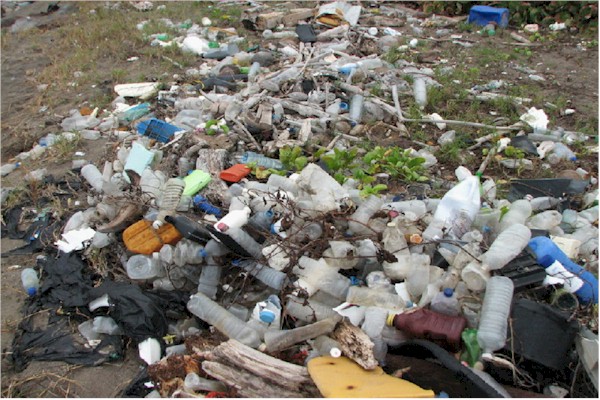
In an e-mail dated Febuary 22nd, 2010, Norton Smith stated:
"I think it is important to begin to show that plastic pollution is not confined
to the Pacific. I do not have photos from the Atlantic gyre, but one can imagine
that if this much plastic is on the beach
there is a lot more out there."
Any garbage that lasts more than
seven years in the Pacific and stays near the surface will migrate to the
center of one of the two areas shown below. Today, most of the garbage in these
regions is plastic, because of its inability to be biodegraded and because of its
abundance -
40% of all plastics are disposed of within a year of production, much of
which ends up in the oceans. Plastics can float, carried by the currents for years,
until they finally are grouped together with the rest of the trash in the center
of the gyres. This causes a long serpent of trash that traces the gyres without
out a head or a tail; almost a continuous train of trash until it reaches its final
destination, referred to as the Convergence Zone. Within the Pacific Ocean this
is principally either the eastern garbage patch in the north east or the western
garbage patch in the north west of the gyre.
In an e-mail dated January 30th, 2010, Miriam Goldstein stated:
"The surface of the gyre is a low-nutrient environment, so there are not many big
fish or marine animals out there, since there is little for them to eat. But like
a terrestrial desert, the gyre harbors many diverse and unique animals that are
adapted to live in challenging conditions."
Later, in an e-mail dated February 7, 2010, Miriam added:
"Much of the marine life in the gyre is very small, about 0.5 mm-5 cm, and cannot
swim against the current. Remember that the plastic is the same size as the zooplankton.
This is what makes this problem so tricky!"
Records of trash in the ocean and on beaches have been kept since the 70's,
however the first actual discovery of the garbage patch was by Captain Charles Moore
on August 3
1997, while on a trip from Hawaii to California.

The circulation in the world's gyres accounts for the eventual accumulation of debris to central areas. Two of these locations are located in the North Pacific and have taken on the popular title "The Great Pacific Garbage Patch." In the North Pacific, the currents comprising the gyre travel at varying speeds, Kuroshio's currents travel at an average speed of 3-4 knots or about 1.54 - 2.06 meters per second, while the North Equatorial Current and North Pacific Current move on average between 0.7 knots or 0.36 meters per second.
Derelict fishing gear is a type of marine debris that was originally fishing equipment. It is specifically damaging. Abandoned nets and pots continue to catch marine life, and trap them until they starve to death. This is called ghost fishing. In shallower areas derelict fishing gear can do great damage to reefs, especially with repeated disturbances. Nets and line from fishing vessels can wrap around the neck or apendages of sea life, and studies have shown that of those entangled many suffer death because of it. Some populations are more effected by the entanglement problem than others. Some species of endangered seals do not get entangled often, but the younger ones are more likely to get entangled which causes a signifcant decline in the popluation. California, Hawaii, and Washington state are addressing this problem with new initiatives and removal programs.
Toxic Derivatives of Plastics in the Ocean
A group of researchers lead by Katsuhiko Saido of Nihon University of Chiba, Japan
has found that, contrary to popular belief, plastic in the oceans can
decompose releasing
Bisphenol A (BPA) in the process. BPA is an industrial chemical used
as the starting material for the production of polycarbonate plastics and synthetic
resins. BPA is found in items or containers that come into contact with foodstuffs
such as drinking vessels, baby bottles, plastic tableware and the internal coating
on tins for tinned-food. In some circumstances, chemicals in food packaging can
migrate into the food product, and vice versa, depending on the nature of the packaging
and the food contained within.
Studies show that BPA can mimic the effects of the female growth hormone,
estrogen. BPA has been linked to heart arrhythmias reproductive problems in females.
Ocean samples around the world, including regions around the United States, Europe, India, and Japan, contain derivatives of polystyrene, styrofoam, and hard plastics; toxic compounds such as styrene trimmer, a polystyrene by-product, and bisphenol A. All of which have leached out of these plastics into the ocean's water. Scientists have simulated this decomposition of polystyrene in sea water validating the release of these same toxins during the physical breakdown of plastics. These toxins can have substantial effects on the oceans ecosystem; in addition to Bisphenol A (BPA), styrene monomer is a suspected carcinogen.
Dave Gilson says, "But broken down plastics are better than litter, right? Wrong. In fact, plastics often create more environmental harm when broken down than when intact. This is most evident in the oceans, home to billions of pieces of disintegrating plastic and preproduction pellets called nurdles, which can work their way back up the food chain to humans."
In an e-mail dated January 30th, 2010, Mirriam Goldstein stated:
In an e-mail dated February 28, 2010, Norton Smith added that:
There is a great concern that these plastics and toxins are doing damage to the ocean's food chain. Marine life mistakenly ingests plastic assuming that they are a food source, contaminating themselves with the toxins and consuming indigestible material. An estimated 44% of seabirds consume plastic as part of their diet, many times causing death by starvation or from the plastic's toxic components. These toxins work their way up the food chain becoming more concentrated as animals consume the contaminated food supply. Eventually, it is believed that this will cause dangerous impurities throughout the entire food chain.
Ocean samples around the world, including regions around the United States, Europe, India, and Japan, contain derivatives of polystyrene, styrofoam, and hard plastics; toxic compounds such as styrene trimmer, a polystyrene by-product, and bisphenol A. All of which have leached out of these plastics into the ocean's water. Scientists have simulated this decomposition of polystyrene in sea water validating the release of these same toxins during the physical breakdown of plastics. These toxins can have substantial effects on the oceans ecosystem; in addition to Bisphenol A (BPA), styrene monomer is a suspected carcinogen.
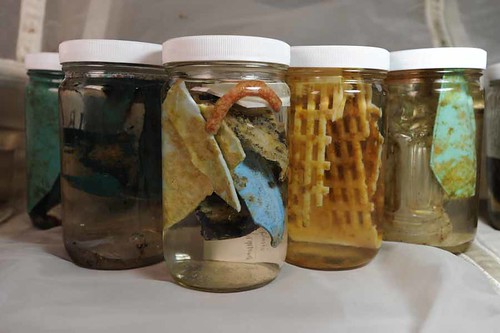
Image courtesy of Seaplex Blog |
 Image courtesy of Mother Nature Network |
Dave Gilson says, "But broken down plastics are better than litter, right? Wrong. In fact, plastics often create more environmental harm when broken down than when intact. This is most evident in the oceans, home to billions of pieces of disintegrating plastic and preproduction pellets called nurdles, which can work their way back up the food chain to humans."
In an e-mail dated January 30th, 2010, Mirriam Goldstein stated:
"Most pieces [of plastic in the gyre] (>90%) are less than 1 cm in diameter."
In an e-mail dated February 28, 2010, Norton Smith added that:
"This is true, but it is important to put the statement in perspective. There are
a tremendous number of large objects; the most damaging may be the nets that get
wrapped in propellers and nets that are still catching fish. If the data in my paper
turns out to be reproducible, most of the mass is in larger objects. I do not know
the cost to shipping, but it was clear that the two large nets we found had been
wrapped around propellers."
There is a great concern that these plastics and toxins are doing damage to the ocean's food chain. Marine life mistakenly ingests plastic assuming that they are a food source, contaminating themselves with the toxins and consuming indigestible material. An estimated 44% of seabirds consume plastic as part of their diet, many times causing death by starvation or from the plastic's toxic components. These toxins work their way up the food chain becoming more concentrated as animals consume the contaminated food supply. Eventually, it is believed that this will cause dangerous impurities throughout the entire food chain.
Babies’ bottles and bisphenol A
http://www.nzfsa.govt.nz/consumers/chemicals-nutrients-additives-and-toxins/bisphenol-a.htm
Coriolis Effect
http://abyss.uoregon.edu/~js/glossary/coriolis_effect.html
Coriolis Force
http://ww2010.atmos.uiuc.edu/%28Gh%29/guides/mtr/fw/crls.rxml
Derelict Fishing Gear
http://www.stillaguamish.nsn.us/derelict%20fishing%20gear.htm
Derelict Fishing Gear and Fish
http://www.nap.edu/openbook.php?record_id=12486&page=89
Do Biodegradable Plastics Really Work?
http://motherjones.com/environment/2009/05/do-biodegradable-plastics-really-work
Ghost Fishing
http://www.jncc.gov.uk/page-1567
Impacts of lost fishing gear on coral reef sessile invertebrates in the Florida Keys National Marine Sanctuary
http://faculty.mdc.edu/mchiappo/publications/fishing_gear_paper_biological_conservation.pdf
In shock to environmentalists, plastic may decompose at sea after all - and that's not good news
http://www.nydailynews.com/lifestyle/2009/08/20/2009-08-20_plastic_may_break_down_in_the_ocean_after_all_the_environmentalist_.html
Introduction to Ocean Gyres
http://oceancurrents.rsmas.miami.edu/ocean-gyres.html
Kuroshio Current large marine ecosystem
http://www.eoearth.org/article/Kuroshio_Current_large_marine_ecosystem
More troubling news about BPA
http://www.sciencenews.org/view/generic/id/44577/title/More_troubling_news_about_BPA
NOAA Marine Debris Program
http://marinedebris.noaa.gov/welcome.html
Ocean Currents
http://www.irbs.com/bowditch/pdf/chapt32.pdf
Origins and Biological Accumulation of Small Plastic Particles in Fur-seal Scats from Macquarie Island
http://www.mindfully.org/Plastic/Ocean/Origins-Small-Plastic-Particles.htm
Plastic bags and plastic bottles - CO2 emissions during their lifetime
http://timeforchange.org/plastic-bags-and-plastic-bottles-CO2-emissions
Plastic Breaks Down in Ocean, After All -- And Fast
http://news.nationalgeographic.com/news/2009/08/090820-plastic-decomposes-oceans-seas.html
Plastic ocean: The Great Pacific Garbage Patch
http://www.cdnn.info/news/article/a071104.html
Reducing Marine Debris: Derelict Fishing Gear Removal Programs in Hawaii, Washington, and California
http://www.highseasghost.net/docs/Gilardi.pdf
Tackling Marine Debris in the 21st Century (2008)
http://www.nap.edu/openbook.php?record_id=12486&page=36
What is the Great Pacific Ocean Garbage Patch?
http://www.mnn.com/earth-matters/translating-uncle-sam/stories/what-is-the-great-pacific-ocean-garbage-patch