Ocean Pollution
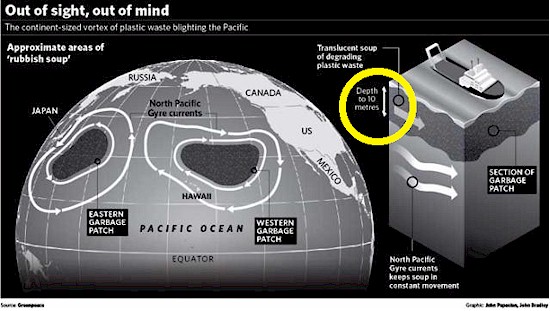
Trash has been building up in the gyres since the very beginning, any thing that
lasts more than
seven years and stays near the surface will build up in trash areas. It may
not necessarily be plastic, however, most of it will be since other types of trash
biodegrade while plastic does not. The way the gyres function, as they gather debris
towards their centers is what causes the plastic build up in these patches. However
plastics can float around trapped in currents for years until they finally are grouped
with the rest of the trash. This causes a long serpent of trash that traces the
gyres without out a head or a tail almost a continuous train of trash with its final
destination principally being either the eastern garbage patch in the north east
or the western garbage patch in the north west of the gyre. The
recording of trash in the ocean and on beaches have been kept since the 70's,
however the first actual discovery of the garbage ring was by Captain Charles Moore
on August 3
1997, while on a trip from Hawaii to California.
Found in samples collected in waters from the United States, Europe, India, and Japan were derivatives of polystyrene, styrofoam, and hard plastics. When scientists later simulated the decomposition of polystyrene in the sea they found behind in the water the same compounds detected in the ocean samples: styrene trimer, a polystyrene by-product, and bisphenol A.
Bisphenol A (BPA) has been shown to interfere with the reproductive systems of animals; while styrene monomer is a suspected carcinogen. About 44 percent of all seabirds eat plastic, often with fatal effects. In addition, many marine species are affected by plastic garbage. For example, animals swallow plastic bags assuming that they are a food source since the floating bags resemble jellyfish in mid-ocean. Pollutants become more concentrated as animals eat other contaminated animals. Ultimately leading to dangerous impurities throughout the entire food chain.
--> (Mother Nature) The reason marine debris is a problem is? .... entanglement, food supply, photodegradation, mechanical tearing ... fishing debris, boating debris, cargo ships, naval vessels, nurdles ....
Found in samples collected in waters from the United States, Europe, India, and Japan were derivatives of polystyrene, styrofoam, and hard plastics. When scientists later simulated the decomposition of polystyrene in the sea they found behind in the water the same compounds detected in the ocean samples: styrene trimer, a polystyrene by-product, and bisphenol A.
Bisphenol A (BPA) has been shown to interfere with the reproductive systems of animals; while styrene monomer is a suspected carcinogen. About 44 percent of all seabirds eat plastic, often with fatal effects. In addition, many marine species are affected by plastic garbage. For example, animals swallow plastic bags assuming that they are a food source since the floating bags resemble jellyfish in mid-ocean. Pollutants become more concentrated as animals eat other contaminated animals. Ultimately leading to dangerous impurities throughout the entire food chain.
--> (Mother Nature) The reason marine debris is a problem is? .... entanglement, food supply, photodegradation, mechanical tearing ... fishing debris, boating debris, cargo ships, naval vessels, nurdles ....

Image courtesy of NOAA Marine Debris Program |
 Image courtesy of Mother Nature Network |
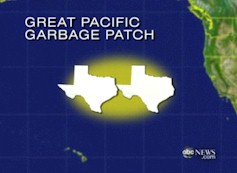 Image courtesy of ABC news (time 1:48) |
Kelp Forests
 Image courtesy of Kelp Forests |
Kelp forests
are the most biologically productive habitats in the marine environment. They occur
in very cold waters, averaging 20ºC. They are found throughout the world in shallow
open coastal waters from the Arctic to the Antarctic Circles. They depend on light
for photosynthesis which restricts them to depths of no more than 15-40 meters.
Kelp has some of the most remarkable growth rates in the plant kingdom and are beautiful
underwater attractions.
Pictured on the left is a forest of Macrocystis pyrifera kelp, in Southern California, which grows up to 30 cm/day. |
| Kelp forests that are in the eastern and northern Pacific have a very complex three-dimensional structure, with many coexisting plant species. Similar to coral reefs, they also support large communities of benthic invertebrates. Because of the environmental impact of kelp forests it is absolutely crucial that they are not harmed any further than they already have been. This means that any debris or pollution can greatly effect their health but we also need to make sure that in removing the debris and pollution we do not harm the sealife and environment of the Kelp Forests. | |
Plastic Ocean: The Great Pacific Garbage Patch
http://www.cdnn.info/news/article/a071104.html
Origins and Biological Accumulation of Small Plastic Particles in Fur-seal Scats from Macquarie Island
http://www.mindfully.org/Plastic/Ocean/Origins-Small-Plastic-Particles.htm
What is the Great Pacific Ocean Garbage Patch?
http://www.mnn.com/earth-matters/translating-uncle-sam/stories/what-is-the-great-pacific-ocean-garbage-patch
Continent-size toxic stew of plastic trash fouling swath of Pacific Ocean
http://www.sfgate.com/cgi-bin/article.cgi?f=/c/a/2007/10/19/SS6JS8RH0.DTL&hw=pacific+patch&sn=001&sc=1000
First Great Pacific Garbage Patch Clean-Up Effort to Begin
http://www.treehugger.com/files/2009/05/first-great-pacific-garbage-patch-clean-up-effor-to-begin-next-month.php
http://www.cdnn.info/news/article/a071104.html
Origins and Biological Accumulation of Small Plastic Particles in Fur-seal Scats from Macquarie Island
http://www.mindfully.org/Plastic/Ocean/Origins-Small-Plastic-Particles.htm
What is the Great Pacific Ocean Garbage Patch?
http://www.mnn.com/earth-matters/translating-uncle-sam/stories/what-is-the-great-pacific-ocean-garbage-patch
Continent-size toxic stew of plastic trash fouling swath of Pacific Ocean
http://www.sfgate.com/cgi-bin/article.cgi?f=/c/a/2007/10/19/SS6JS8RH0.DTL&hw=pacific+patch&sn=001&sc=1000
First Great Pacific Garbage Patch Clean-Up Effort to Begin
http://www.treehugger.com/files/2009/05/first-great-pacific-garbage-patch-clean-up-effor-to-begin-next-month.php