Mining Methods and Helium-3 Extraction
Mining in general can be categorized into two methods, underground mining and surface mining. Below you can view a graphic illustrating different mining methods.
Underground mining consists of drift, slope, and shaft mining, and actual mining techniques like room, pillar, and longwall mining.
Lunar Mining and Helium-3 Extraction
Before the moon can be mined the area has to be investigated. According to Charles E. Glass, there are two different types of moon areas: Apollo sites, which are the area that have been searched and documented, and generic sites, which are areas of the moon have never been visited but might have potential to mining. In other words, we would have to survey the site and take samples before we start the mining process. To survey the moon, a robot will sample and analyze the soil. U.S. roboticists have begun work on a lunar rover that can drill into the surface and take samples. This rover has to be well built to withstand harsh conditions including vast temperature changes. The rover has to operate on minimal energy levels so that it can operate in the dark areas without running out of power until the sun returns to charge the batteries through the use of solar panels. Thus, the robot has to have a lightweight body to conserve energy in the transportation process. Once the sample is analyzed the information will be sent to base for further analysis to decide if the sampled area contains a significant amount of helium to begin mining.
Mining the moon is starting to be a very popular topic. The Chinese government is planning on building a mining device that has a large bucket wheel on the front which is attached to a pivoting arm. The arm allows the machine move through short distances while still collecting tons of moon dust, or regolith. Once dredged up, the regolith continues through a filter that removes any large debris, including stones. Much of the 3He will be shaken loose merely by handling the dust. After the filtration the remaining dust enters a solar heater that heats the dust up above 800 degrees Celsius, releasing any trapped gases. These gases, including 3He will be stored in containers and delivered to the moon base where the gases are separated. The leftover soil will be pumped out behind the extractor, returning it to the lunar surface.
NASA's version is very similar. It is comprised of a bucket-and-reel system, or slusher system, that pulls the dirt up a ramp and into a hauler. This method has been used on Earth and is considered adaptable for use on the Moon.
The top layer of the lunar surface is a glassy, powdery mix of minerals deposited by solar rays and asteroids striking the surface.
The mining method used depends upon the desired goal or product. Four main issues are outlined below:
The mining of 3He from the moon would be astronomically beneficial to everyone everywhere. Gerald Kulcinski, a longtime advocate and leading pioneer in the field of fusion research at the University of Wisconsin, estimates that helium-3 would have a cash value of $4 billion a ton in terms of its energy equivalent in oil. According to Apollo 17 astronaut Harrison Schmitt, 25 tons of 3He could easily power the United States for a year.
The moon will not be harmed or disfigured in any major way. Because the helium-3 only accounts for a small concentration, 20 parts per million, of the lunar dust's composition, we would be required to mine a million tons of lunar dust to produce around 70 tons of 3He. We would only be sifting through the dust, not creating any major ruts or grooves in the surface.

Underground mining consists of drift, slope, and shaft mining, and actual mining techniques like room, pillar, and longwall mining.
-
Drift mines enter horizontally into the side of a hill; slope mines enter a valley at the bottom and slope down toward the mine; shaft mines are the deepest type, a vertical shaft into the ground with an elevator.
-
Room mining is cutting a network of rooms into mine seams. As the rooms are cut into the mine, a continous mining machine loads the material onto a shuttle cart, and the material is placed on a conveyor belt to be brought up to the surface. Below is a picture of a continuous mining machine.
-
Pillar mining is constructing pillars of the material to support the roof of the mine. This method normally causes a 60 percent reduction in recovery of material because the material is left behind as pillars. As the mining continues, roof bolts are placed in the ceiling to prevent it from collapsing. Under necessary circumstances, pillars are moved toward the end of the mine, a process called retreat mining. The pillars are removed in the opposite direction of the advancing mine, hence the term "retreat mining". Below is a picture of a bolted roof.
-
In longwall mining, mechanized shearers cut and remove the material, and conveyor belts carry it to the surface. Temporary hydraulic-powered beams support the roof when the extraction process occcurs. This method is more efficient than room or
pillar mining, with a recovery rate of 75 percent. However, the equipment is more expensive than room and pillar equipment, and cannot be used in all geological situations. As the mine extends into the mountain, roof bolts are placed in the main tunnel ceilings to prevent a collapse. The material behind the panels holding the roof is allowed to collapse because it does not impede the machinery.


-
Area mines are surface mines that remove shallow material over a broad, flat area.
-
Dragline shovels remove any rocks covering the material. After the material is removed, the shovel places the rock back in its place. Below are pictures of an area mine and a dragline shovel.
-
Contour mines are surface mines in a mountainous terrain. A wedge of rock is removed along the side of a hill, the material is removed, and the rock is placed back to restore the mountain to its original slope. Below is a picture of a contour mine. Augur mines are operated in contour mines before they are covered up. The material that cannot be reached is drilled or augured out.
-
Mountaintop removal mines are area mines where thick seams of the material are present at or near the top of the mountain. Large amounts of rock are removed and placed into the valleys next to the mine.


Lunar Mining and Helium-3 Extraction
Before the moon can be mined the area has to be investigated. According to Charles E. Glass, there are two different types of moon areas: Apollo sites, which are the area that have been searched and documented, and generic sites, which are areas of the moon have never been visited but might have potential to mining. In other words, we would have to survey the site and take samples before we start the mining process. To survey the moon, a robot will sample and analyze the soil. U.S. roboticists have begun work on a lunar rover that can drill into the surface and take samples. This rover has to be well built to withstand harsh conditions including vast temperature changes. The rover has to operate on minimal energy levels so that it can operate in the dark areas without running out of power until the sun returns to charge the batteries through the use of solar panels. Thus, the robot has to have a lightweight body to conserve energy in the transportation process. Once the sample is analyzed the information will be sent to base for further analysis to decide if the sampled area contains a significant amount of helium to begin mining.
Mining the moon is starting to be a very popular topic. The Chinese government is planning on building a mining device that has a large bucket wheel on the front which is attached to a pivoting arm. The arm allows the machine move through short distances while still collecting tons of moon dust, or regolith. Once dredged up, the regolith continues through a filter that removes any large debris, including stones. Much of the 3He will be shaken loose merely by handling the dust. After the filtration the remaining dust enters a solar heater that heats the dust up above 800 degrees Celsius, releasing any trapped gases. These gases, including 3He will be stored in containers and delivered to the moon base where the gases are separated. The leftover soil will be pumped out behind the extractor, returning it to the lunar surface.
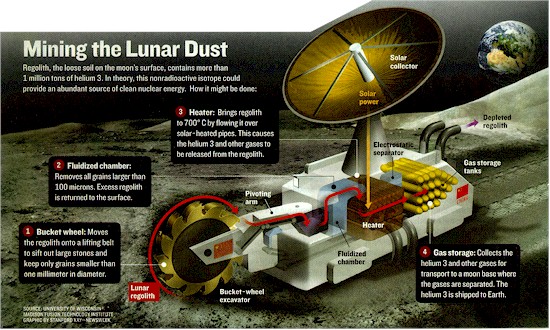
NASA's version is very similar. It is comprised of a bucket-and-reel system, or slusher system, that pulls the dirt up a ramp and into a hauler. This method has been used on Earth and is considered adaptable for use on the Moon.
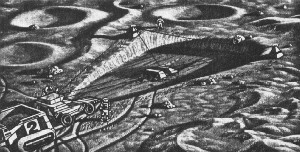
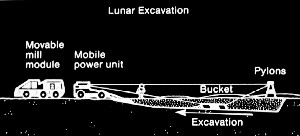
The top layer of the lunar surface is a glassy, powdery mix of minerals deposited by solar rays and asteroids striking the surface.
"Yes, the surface is fine and powdery. I can kick it up loosely with my toe. It does adhere in fine layers, like powdered charcoal, to the sole and sides of my boots. I only go in a small fraction of an inch, maybe an eighth of an inch, but I can see the footprints of my boots and the treads in the fine, sandy particles." Neil Armstrong, Apollo 11 (109:25:08)
The mining method used depends upon the desired goal or product. Four main issues are outlined below:
-
The first issue involved in mining is dense lunar soil (under the lunar dust) that is difficult to drill. Old magma oceans as well as meteor impacts over time have shifted soil particles to dense orientations. Experiments in lunar mining should first prepare the soil with vibration, not compression.
-
The second issue is creating friction in a vacuum environment. The U.S. Bureau of Mines found that friction between a tool and lunar material is 1.5 to 60 times that created on Earth. This effect will be augmented by "incompletely oxidized material and total absence of moisture."
-
The third issue is operating the mining equipment in extreme temperatures. In the day, the equipment will need to either withstand 140°C (280°F) temperatures or operate under a partial sunscreen with foil mirrors to allow some light through. At night, surface mining will need to be sheltered in a tunnel garage or canopy with heaters.
- The forth issue is that the mining and processing equipment must be engineered to specifically work on the moon. The equipment must work in a vacuum on electricity instead of petrol. In addition, the equipnment must work in one-sixth the gravity of Earth.
The mining of 3He from the moon would be astronomically beneficial to everyone everywhere. Gerald Kulcinski, a longtime advocate and leading pioneer in the field of fusion research at the University of Wisconsin, estimates that helium-3 would have a cash value of $4 billion a ton in terms of its energy equivalent in oil. According to Apollo 17 astronaut Harrison Schmitt, 25 tons of 3He could easily power the United States for a year.
The moon will not be harmed or disfigured in any major way. Because the helium-3 only accounts for a small concentration, 20 parts per million, of the lunar dust's composition, we would be required to mine a million tons of lunar dust to produce around 70 tons of 3He. We would only be sifting through the dust, not creating any major ruts or grooves in the surface.
1st Space Exploration Conference - The Lunar Dust Problem: From Liability to Asset
http://www.cden.ca/2005/2ndCDEN-conference/data/10201.pdf
Apollo 11 - Lunar Surface Journal
http://www.hq.nasa.gov/office/pao/History/alsj/a11/a11.step.html
CBC News - Rover with Canadian-made drill to test lunar mining prospects
http://www.cbc.ca/technology/story/2007/09/21/tech-rover-drill.html
McGill University - A Review of Mining Technologies For Space
http://www.cden.ca/2005/2ndCDEN-conference/data/10201.pdf
Ministério da Ciência & Tecnologia - Fusion Reactions
http://www.plasma.inpe.br/LAP_Portal/LAP_Site/Text/Fusion_Reactions.htm
Nanomedicine, Volume I: Basic Capabilities - Nuclear Fusion
http://www.nanomedicine.com/NMI/6.3.7.2.htm
Newsweek - To Reach For The Moon
http://fti.neep.wisc.edu/gallery/pdf/nw021207.pdf
Permanent - Mining the Lunar Surface
http://www.permanent.com/l-mining.htm
Ralston Middle School - Lunar Site Characterization and Mining
http://www.belmont.k12.ca.us/ralston/programs/itech/SpaceSettlement/spaceresvol3/lscam1.htm
SPACE.com - Researchers and space enthusiasts see helium-3 as the perfect fuel source
http://www.space.com/scienceastronomy/helium3_000630.html
Star Bulletin - UH scientists envision mining town on moon
http://starbulletin.com/2007/02/18/news/story02.html
University of Kentucky - Bolted roof
http://www.uky.edu/KGS/coal/bolt_roof.htm
University of Kentucky - Continuous-mining machine
http://www.uky.edu/KGS/coal/Con_miner_pic.htm
University of Kentucky - Contour mining
http://www.uky.edu/KGS/coal/contour1.htm
University of Kentucky - Dragline
http://www.uky.edu/KGS/coal/dragline.htm
University of Kentucky - Methods of Mining
http://www.uky.edu/KGS/coal/coal_mining.htm
University of Kentucky - Surface mining
http://www.uky.edu/KGS/coal/surface_mining.htm