Helium-3
Solar wind is the formation of charged particles emitted from the corona of the sun. The speed of solar wind has been noted to move as fast as 900 kilometers per second. The Aurora Borealis is an example of a solar wind that you can see from the Earth when light is emitted as the gas atoms in our atmosphere are excited by the charged particles. Geomagnetic storms are caused by solar winds which can temporarily knock out the power grids located on the Earth. When the moon is struck by solar wind, the charged particles leave behind Helium-3 in the outermost surface layer of the moon. Later on meteorites striking the moon's surface plow the Helium-3 into deeper layers acting as tillers exposing more of the moon's layers to Helium-3. Every sample that has been extracted from the moon has had trace amounts of Helium-3. Some samples have been extracted a meter deep into the surface of the moon and Helium-3 has still been found.
Helium-3 is a rare isotope, having two protons and only one neutron, of commonly found Helium-4. The special part about 3He is that it is extremely receptive to fusion reactions which produce a massive amount of energy with little residual radioactivity. We have not had the ability to do this before because the earth lacks this isotope since our atmosphere blocks solar winds which contain the 3He. The moon on the other hand is abundant with it. Scientists estimate that there is about one million tons of Helium-3 on the moon, imbedded in an ore called ilmenite, which is enough to power the entire world for thousands of years. To liberate the Helium, the ore has to be heated to about 700-800 degrees Celsius.
Unfortunately gathering enough moon dust to produce sufficient amounts of 3He could be a major obstacle. The substance is scattered all across the moon's surface, and is not highly concentrated. To obtain 70 tons of 3He, millions of tons of moon dust would have to be gathered and purified.
The estimated cost to transfer the helium between Earth and the moon is roughly 40,000 to 60,000 dollars per kilogram where it has been estimated that 3He has a cash value of 5.7 million dollars per kilogram. These prices would make a trip to the moon well worth it.
Two Helium-3 atoms. when combined in a super heated plasma, fuse briefly to create an unstable molecule before breaking apart into a Helium-4 atom and two protons. The things produced when the unstable molecule breaks apart are traveling at extremely high speeds, so they carry a lot of energy. This produces 12.9 MeV (megaelectronvolts) of energy. One of the protons carries 8.9 MeV and the other carries 3.2 MeV, the remaining 0.8 MeV is carried by the Helium-4, an alpha particle.
To be combined, the Helium-3 atoms must overcome their electrostatic repulsion because of the fact that the nuclei are both positively charged. When the nuclei come close enough together the stronger nuclear force pulls them together, creating the unstable atom. To make the nuclei come close enough together they must be moving very quickly. One of the most effective ways to do this is to make it into superheated plasma. Being superheated, their kinetic energy can get them close enough together. When superheated like this it must be contained magnetically. It is currently easiest to contain it is a Tokamak. There have been tokamaks that were able to produce temperatures high enough to start fusion, like the TFTR (Tokamak fusion test reactor).
There has been a reactor designed specifically for third-generation Helium-3 fusion by Gerald Kulcinski at the University of Wisconsin.

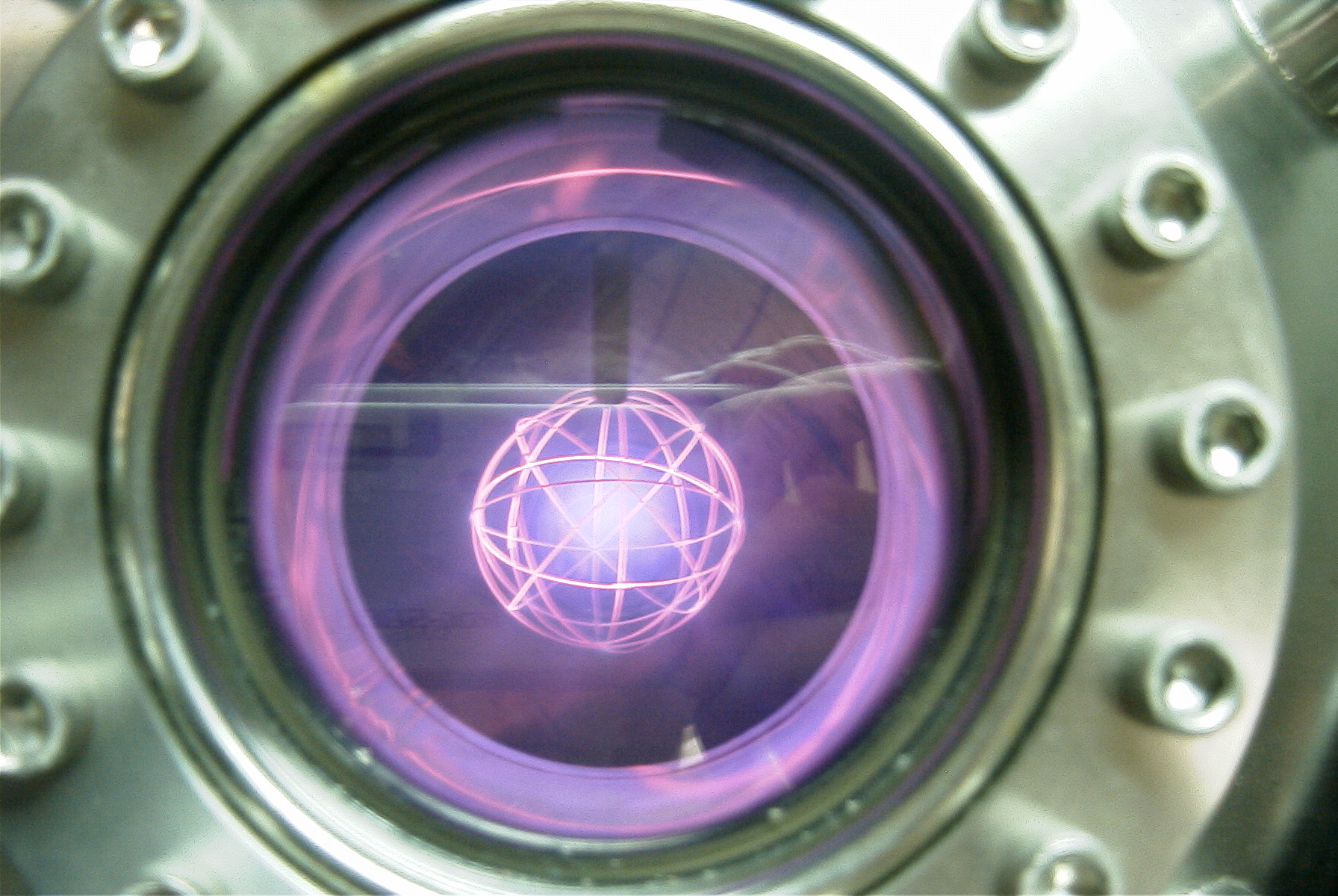
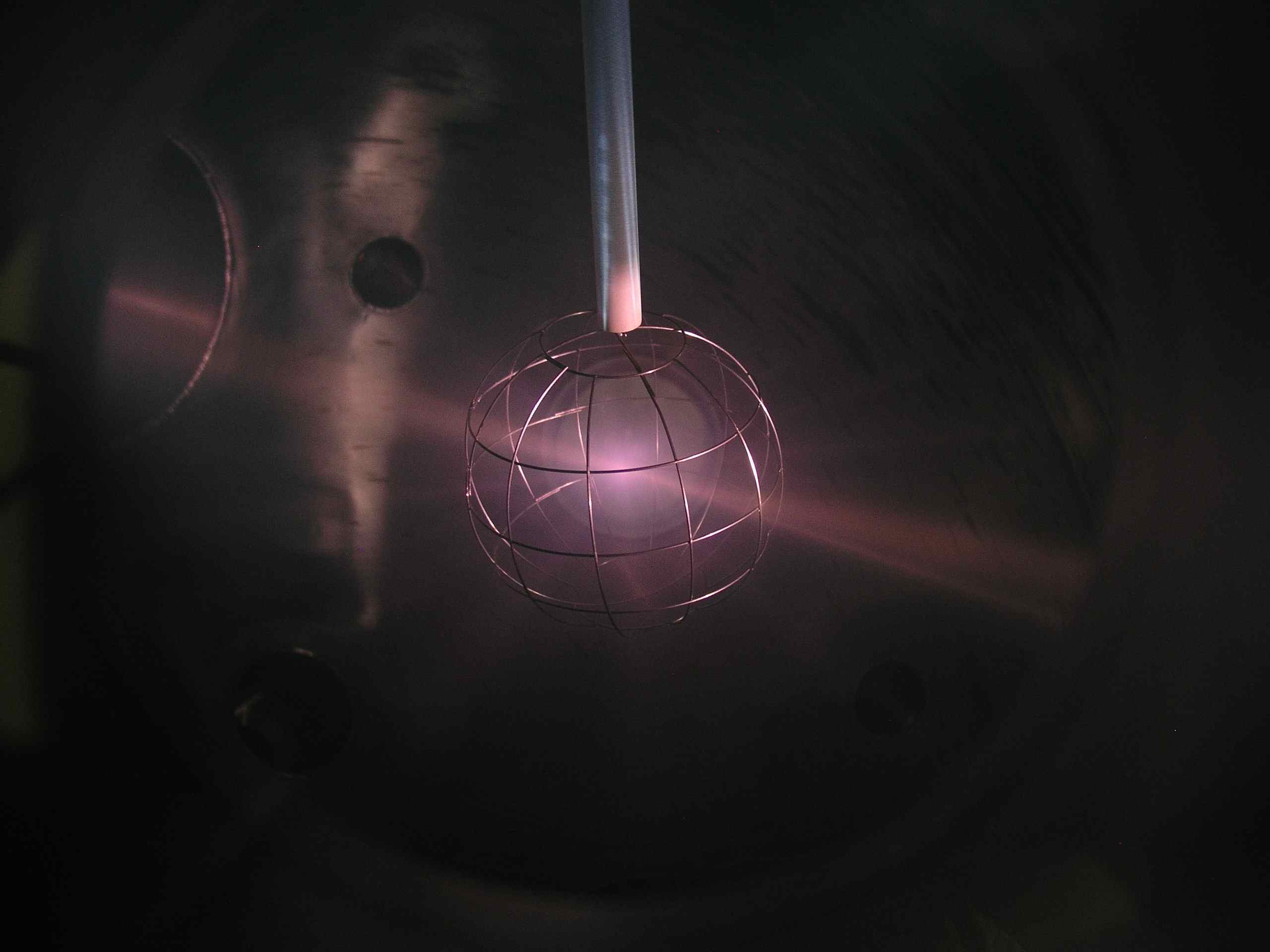
This reaction produces large amounts of energy with very little harmful by product. Kulcinski thinks that using a tokamak is overly expensive and complicated. Instead of using an electromagnetic field, his reactor uses an electrostatic field. Kulcinski's Inertial Electrostratic Confinement IEC reactor makes and contains a 10-cm sphere that can sustain Helium-3 fusion. He thinks that he can better collect the energy produced by these reactions by using a reverse particle accelerator that can convert the power directly into electricity without the need of turning a turbine.

Helium-3 is a rare isotope, having two protons and only one neutron, of commonly found Helium-4. The special part about 3He is that it is extremely receptive to fusion reactions which produce a massive amount of energy with little residual radioactivity. We have not had the ability to do this before because the earth lacks this isotope since our atmosphere blocks solar winds which contain the 3He. The moon on the other hand is abundant with it. Scientists estimate that there is about one million tons of Helium-3 on the moon, imbedded in an ore called ilmenite, which is enough to power the entire world for thousands of years. To liberate the Helium, the ore has to be heated to about 700-800 degrees Celsius.

Unfortunately gathering enough moon dust to produce sufficient amounts of 3He could be a major obstacle. The substance is scattered all across the moon's surface, and is not highly concentrated. To obtain 70 tons of 3He, millions of tons of moon dust would have to be gathered and purified.
The estimated cost to transfer the helium between Earth and the moon is roughly 40,000 to 60,000 dollars per kilogram where it has been estimated that 3He has a cash value of 5.7 million dollars per kilogram. These prices would make a trip to the moon well worth it.
Helium-3 Fusion Reactor
Two Helium-3 atoms. when combined in a super heated plasma, fuse briefly to create an unstable molecule before breaking apart into a Helium-4 atom and two protons. The things produced when the unstable molecule breaks apart are traveling at extremely high speeds, so they carry a lot of energy. This produces 12.9 MeV (megaelectronvolts) of energy. One of the protons carries 8.9 MeV and the other carries 3.2 MeV, the remaining 0.8 MeV is carried by the Helium-4, an alpha particle.
To be combined, the Helium-3 atoms must overcome their electrostatic repulsion because of the fact that the nuclei are both positively charged. When the nuclei come close enough together the stronger nuclear force pulls them together, creating the unstable atom. To make the nuclei come close enough together they must be moving very quickly. One of the most effective ways to do this is to make it into superheated plasma. Being superheated, their kinetic energy can get them close enough together. When superheated like this it must be contained magnetically. It is currently easiest to contain it is a Tokamak. There have been tokamaks that were able to produce temperatures high enough to start fusion, like the TFTR (Tokamak fusion test reactor).
There has been a reactor designed specifically for third-generation Helium-3 fusion by Gerald Kulcinski at the University of Wisconsin.
This reaction produces large amounts of energy with very little harmful by product. Kulcinski thinks that using a tokamak is overly expensive and complicated. Instead of using an electromagnetic field, his reactor uses an electrostatic field. Kulcinski's Inertial Electrostratic Confinement IEC reactor makes and contains a 10-cm sphere that can sustain Helium-3 fusion. He thinks that he can better collect the energy produced by these reactions by using a reverse particle accelerator that can convert the power directly into electricity without the need of turning a turbine.
|
|
| Images courtesy of The University of Wisconson | |
EFDA-JET - About Tokamaks
http://www.jet.efda.org/pages/faqs/faq2.html#3003
Lawrence Berkeley National Laboratory - ABC's of Nuclear Science
http://www.lbl.gov/abc/Basic.html
NASA Stargazers - Solar Winds and CMES
http://stargazers.gsfc.nasa.gov/students/solar_winds_cmes.htm
Northwestern University - What is solar wind?
http://www.qrg.northwestern.edu/projects/vss/docs/space-environment/3-what-is-solar-wind.html
Popular Mechanics - Mining The Moon
http://www.popularmechanics.com/science/air_space/1283056.html?page=4
Princeton Plasma Physics Laboratory - Tokamak Fusion Test Reactor
http://www.pppl.gov/projects/pages/tftr.html
redOrbit - Glossary
http://www.redorbit.com/education/reference_library/glossary/
SPACE.com - Researchers and space enthusiasts see helium-3 as the perfect fuel source
http://www.space.com/scienceastronomy/helium3_000630.html
Space Physics - Geomagnetic Storms Can Threaten Electric Power Grid
http://www.agu.org/sci_soc/eiskappenman.html
The Space Review - A fascinating hour with Gerald Kulcinski
http://www.thespacereview.com/article/536/1
The Triunity Report - There’s Helium-3 in them there Moon hills!
http://www.direct.ca/trinity/helium3.htm
University of Wisconsin-Madison - General Operation II
http://iec.neep.wisc.edu/photopages/GeneralOpPicsII.htm
University of Wisconsin-Madison - Inertial Electrostatic Confinement Fusion
http://iec.neep.wisc.edu/operation.php
University of Wisconsin-Madison - Progress and Research on 3He Fusion Reactions at UW-Madison
http://fti.neep.wisc.edu/presentations/piefer_iec06.pdf (pg 3)