Steel
Barges can well be defined as enormous steel "creations" designed for recreation, transportation, and other economic purposes. If you would ask a barge owner what kind of material his or her barge is made out of you will almost always hear steel. Steel and the steel industry are so intertwined in the construction of barges that some future barge buyers often wait for a decrease in steel prices before they purchase their barge.In 1855, an Englishman named Bessemer designed and constructed the first furnace(converter) for creation of "cast" iron by combining pig iron (4 to 5% carbon), which is not commonly used as a material, because it is brittle, and wrought iron, which has an extremely low percent carbon.
The $998 billion steel industry, is one of the leading industries in the world. Many things from fridges to barges is made out of some form of steel. So how exactly is steel made? This is a question that requires a complex answer. The main way steel is formed is illustrated by the following flow chart.

This flow chart can be subdivided in to two processes, the KOBM (Basic Oxygen Steelmaking) Stream, and the EAF (Electric Arc Furnace) Stream. The KOBM stream uses mainly iron ore, coal, and limestone, while the EAF stream uses mainly recycled scrap. The KOBM Stream goes as follows:
- First you input raw coal into a coke oven, which is later put into a blast furnace with the coal, iron ore, and limestone. (This produces molten metal from iron ore)
- After that, you put the newly manufactured molten iron ore into the basic oxygen furnace to produce the molten steel.
- Next the molten steel is put into a steel refining facility which ships it to the continuous casting system to produce steel slabs.
- These steel slabs are then transported to rolling mills to be rolled out for selling.
- An alternative way through the KOBM stream is to put recycled steel into the basic oxygen furnace and continue as above.
Though steel is a very strong and sturdy compound, it can have faults. Through the combining of iron (III) oxide and carbon monoxide, iron and carbon dioxide, also as known as steel, is produced. If you noticed, iron is present in steel, and iron is a mildly reactive metal that can easily return to its oxide state. When in the oxide state, or the binary compound of an element with oxygen, rusting can occur. Because of the fact that iron is present in steel, many steel industries now have decided to galvanize their steel before selling because once steel has been galvanized, it lasts longer, remains stronger, and increases the resistance against rusting. This "galvanizing" process is not some simple detour towards getting the steel you see today; this process takes numerous steps before the finished product is available.
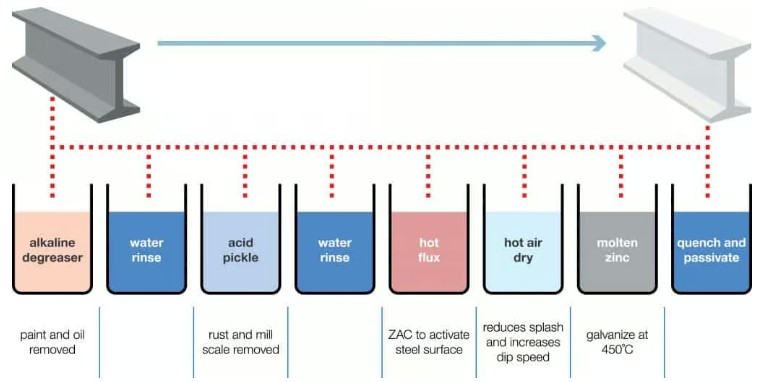
The Four Main Steps in Galvanizing Steel:
- The first step in the process is called a caustic cleaning, which removes oils, greases, and some mill scale also known as fine steel particles.
- In the next step, the steel goes through an acid pickling bath to remove surface rust and inner rust.
- In the third step, the steel is dipped in a flux solution, also known as "fluxing", which applies a preserving surface to arrest any oxidation of the steel.
- Lastly, the steel is then immersed in molten zinc; zinc is chosen for its renowned rust-resistance qualities.
- In addition to the four main steps, the steel goes through a thorough rinsing after the caustic cleansing and the acid bath to reduce contamination and halt the previous process. After the "fluxing", the steel is set to dry before entering the molten zinc. After this, the newly galvanized steel is then cooled and inspected before selling.
American Galvenizers Association
http://www.galvanizeit.org/resources/files/AGA%20PDFs/T_ZC_00.pdf
American Iron and Steel Institute
http://www.steel.org/am/template.cfm?section=construction
Chemistry of Steelmaking
http://www.schoolscience.co.uk/content/4/chemistry/steel/msch1pg1.html
Industrial Galvanizers Corporation
http://www.corp.indgalv.com.au/technical/manual.htm
Met Soc Steel Production Flow-Sheet
http://www.metsoc.org/virtualtour/processes/steel.asp