School Teacher
|
Technical
Applications Technical Advisors Technical Support
Specialist Opening Graphic Student Editors |
||||||||||||||||||||
|
|||||||||||||||||||||
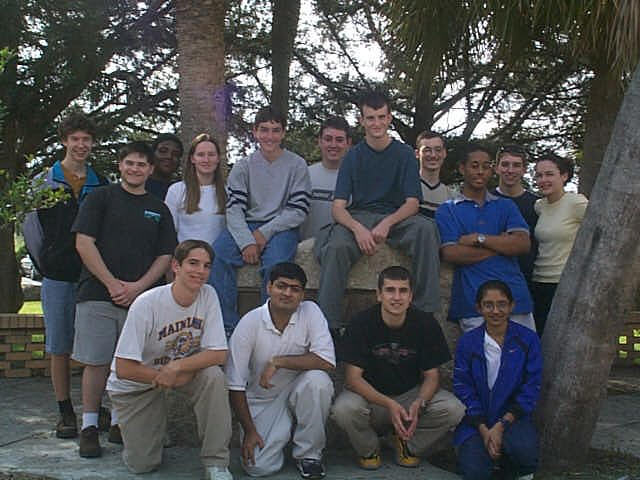
We here at Mainland High School chose the National Critical Technology of Environmental Quality, with a technical application on Pollution Control. More specifically, our project has an environmental impact in the area of Wastewater Management. The global crisis, the geometric growth of human population, has placed severe restrictions on the ability for expansion. This has caused most major hubs of civilization to reach to the skies, constructing towering buildings to enclose offices and housing. With this increase of customers, and the limitation of the land area to grow into, a stress is placed upon wastewater treatment plants attempting to accommodate the massive flow. Logically, when the average quantity of sewage arriving at the plant is near the upper limit, the treatment facility must plan to scale their capacity to match. What is done when there is no more land in which the new tanks must reside? The current method is to sprawl these plants over a great many acres, wasting valuable land which could otherwise be productively exploited. Our solution is to combine all of the components of a wastewater treatment plant into a single structure. This structure would house all of the tanks, pumps, pipes, and chambers needed to handle a certain percentage of the influx. With a vertical combination of the requisite elements, the amount of land area needed will be reduced to the size of one of the tanks. As an added benefit, the culmination of a regular sewage treatment plant and a sludge digester makes for in house production of methane. This volatile gas is useful as a renewable fuel source. The digested sludge is lower in volume than the non-digested sludge, because some is consumed during the methane production process; this means that less is regulated to a landfill. The ease which a structure would allow for the capture of methane is beneficial on two levels. Primarily, the methane is an extremely deleterious greenhouse gas and strict regulations are in place to cease its release; in addition, as mentioned above, the methane could be used as an energy source to provide power for each unit. In the near future, when this technology is better realized, educated people will occupy all of the careers related to this solution since knowledge of chemistry, biology, and physics are all requirements for maintaining a biomass facility. Engineering such facilities will also provide a field of scientific study, since each system must be scaled to the specific location for maximum efficiency. The demand for these professions will increase significantly along with the increased need for smarter, more learned employees. The Administration of Mainland High School has given its permission for our project's homepage to be hosted at the address http://mainland.cctt.org/istf2000 for the duration of this competition until the end of March 2000. |