| NAME __________________________________ | CLASS _________________ | DATE _________________ |

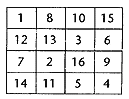
| A magic square is a square array of numbers arranged so that the sum of each row, column, and main diagonal is equal to the same "magic-square" constant. In this project you will investigate some properties of magic squares and construct magic squares by using algebraic expressions. Then you will learn another way to arrange algebraic expressions so that they have "magical" properties. |
| 1.
|
Add the numbers in each row, column, and diagonal of this square array of numbers. How are the sums related. |
|
| __________________________________________________ | ||
| __________________________________________________ | ||
| 2.
|
This array has six broken diagonals: (8, 3, 9, 14)' (10, 6, 7,
11); (10, 13, 7, 4); (8, 12, 9, 5); 12, 2, 5, 15); (12, 2, 5, 15).
Find the sum of the numbers in each broken diagonal. How are the sums related? __________________________________________________ __________________________________________________ |
|
| 3.
|
A magic square is said to be panmagic if the sum of each broken
diagonal is also equal to the magic square constant. Is the square array in Exercise 1 a
panmagic square? Explain. __________________________________________________ __________________________________________________ |
|
| 4.
|
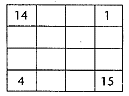
Rotate the square array from Exercise 1 counterclockwise 90 degrees by
filling in this square array. Describe any "magical" qualities of the new square
array. __________________________________________________ __________________________________________________ |
|
| 5.
|
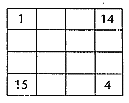
Now reflect the square array from Exercise 4 about the vertical axis by
filling in this square array. Describe any "magical" qualities of this square
array. __________________________________________________ __________________________________________________ |
|