|


| Suppose that you are a traffic-light timing expert for a medium sized city with an increasing population. More people means more drivers, which means more traffic control devices. Use what you learned about fractions, percents, ratios, proportions, probabilities, and decimals to solve these problems involving the timing of traffic lights. |
|
 |
||||||||
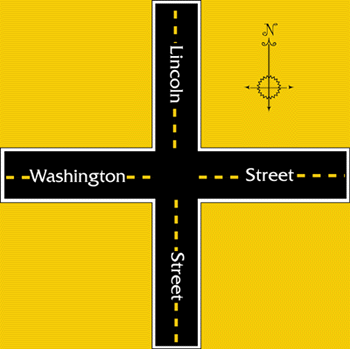
The light at the same intersection on Lincoln
Street is green for 1 1/2 minutes, yellow for 1/2 minute, and red for 4 minutes.
Write the fractions for the amount of time in minutes that the light spends on each color
for one cycle. Be sure to write them in simplest form.
|
| On Sunday through Thursday the traffic lights at this intersection operate from 5:00 am until 10:00 pm. The remainder of the time, the lights flash yellow in one direction and red in the other direction. Based on the timing ratios you calculated above, calculate the number of minutes that the lights are on each color on a Monday. Remember to consider only the amount of time the lights are operating normally, not flashing. |
|
| On Friday and Saturday, the same traffic lights operate on the same cycle from 5:00am until midnight. Calculate the number of minutes that the lights are each color on a Friday. |
|
| Calculate the amount of time in hours that the lights spend on each color for one week: Sunday at 5:00 am to Saturday at midnight. Give your answer in hours and fractions of hours, not in hours and minutes. |
|
| Write the ratios for the colors of the traffic light in terms
of number of hours on each color in one week number of hours operating normally(not flashing) in a week |
|
| Convert these ratios to percents. |
|
The intersection is becoming busier, and the traffic light
timing needs to be altered. If the times for one cycle are altered as listed below,
write the fractions for the amount of time in seconds that the light spends on each color
for one cycle. Be sure to write in simplest form.
|
|