Projectile Motion
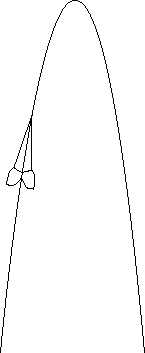
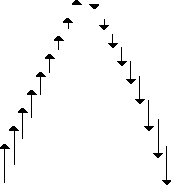
| Introduction What do a baseball, a jumping ballerina, and a rocket have in common? Each goes up into the air and comes back down again. At least temporarily, anything that is thrown or launched into the air is a projectile. The path followed by a projectile is called a trajectory. Figure 1 shows the shape of the trajectory of a toy rocket. The motion of the projectile is up and then down. Figure 2 shows the size and direction of the vertical velocity of a toy rocket at different moments along its trajectory. The rocket's upward velocity begins to decrease immediately after launch and the rocket begins to slow down. Then, for an instant at the highest point of its trajectory, it stops moving because its upward velocity is zero. The rocket immediately begins to fall and its downward velocity increases as it falls. As you can see, the downward trajectory of the rocket mirrors the shape of the upward trajectory. The entire trajectory forms the shape of a parabola. (baseballs flying through the air also follow a parabola-shaped path.) In this experiment, you will collect data about the motion of projectiles and use your data to model a projectile's motion algebraically. Objectives
Materials
|
Figure 1
Figure 2 |
Copyright 1997-1999: html adaptation
Career Connection to Teaching with Technology