Day 4 Classwork: "Order of Operation"
Numerical and algebraic expressions often contain more than one operation. A rule is needed to let you know which operation to perform first. This rule is called the order of operations
Order of Operations
or P lease E xcuse
M y D ear A unt S ally
- Simplify the expressions inside grouping symbols, such as parentheses, brackets, and braces.
- Evaluate all powers or exponents.
- Do all multiplication and division from left to right.
- Do all addition and subtraction from left to right.
From now on you must use "order of operations" when evaluating or solving math problems.
Lets try some problems using "order of operations."
Evaluate 5 * 7 - 6 / 2 + 32 = 5 * 7 - 6 / 2 + 9
Evaluate 32 = 35 - 6 / 2 + 9
Multiply 5 by 7 = 35 - 3 + 9
Divide 6 by 2 = 32 + 9
Subtract 3 from 35 = 41
Add 32 and 9 In mathematics, grouping symbols such as parentheses ( ), brackets [ ], and braces { }, are used to clarify or change the order of operations. They indicate that the expression within the grouping symbol is to be evaluated first. When more than one grouping symbol is to be evaluated within the innermost grouping symbols.
Evaluate 8[62 - 3(2 + 5)] / 8 + 3 = 8[62 - 3(7)] / 8 + 3
Add 2 + 5, the innermost group = 8[36 - 3(7)] / 8 + 3
Evaluate 62 = 8[36 - 21] / 8 + 3
Multiply 3 by 7 = 8[15] / 8 + 3
Subtract 21 from 36 = 120 / 8 + 3
Multiply 8 by 15 = 15 + 3
Divide 120 by 8 = 18
Add 15 and 3 Algebraic expressions can be evaluated when the values of the variables are known. First, replace the variables by their values. Then calculate the value of the numerical expression.
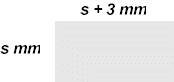
The figure at the right is a rectangle.
- Find the perimeter of the rectangle when s = 5
- Find the area of the rectangle. when s = 5
- The perimeter of the rectangle is the sum of 2 times the measure of the width (s) and 2 times the measure of the length (s + 3).
P = 2s + 2(s + 3)
P = 2(5) + 2(5 + 3)
Replace the variable s with 5 P = 2(5) + 2(5 + 3)
Add 5 and 3 P = 2(5) + 2(8)
Multiply 2 and 5 P = 10 + 2(8)
Multiply 2 and 8 P = 10 + 16
Add 10 and 16 P = 26
b. The area is the product of the width (s) and the length (s +3). A = s(s + 3)
A = 5(5 + 3)
Replace the variable s with 5. A = 5 (8)
Add 5 and 3. A = 40
Multiply 5 and 8 The fraction bar is another grouping symbol. It indicates that the numerator and denominator should each be treated as a single value.
2 * 3 means (2 * 3) ÷ (1 + 2) = 6 / 3 or 2
1 + 2
x2 - y2[(4.2)3 + (1.8)3] ÷ [(4.2)2 - (1.8)2]
Replace x with 4.2 and y with 1.8 [74.088 + 5.832] ÷ [17.64 - 3.24]
Evaluate each value 79.92 ÷ 14.4
5.55
Copyright 1997-1999: html adaptation
Career Connection to Teaching with Technology