Multiplying Polynomials
The following examples show how the distributive property and collecting like terms can be used to multiply any two polynomials.
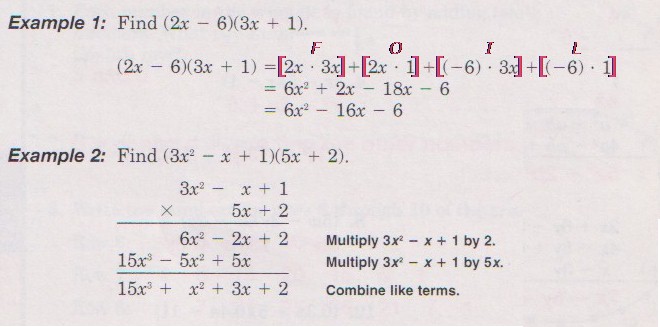
Example 1 illustrates the use of the F O I L method - first, outer, inner, last. This method is usually employed when the problem is presented as the product of two "horizontal" binomials.
Example 2 shows that polynomials can be multiplied vertically.
Directions: Find each product.
1. (5t + 4)(2t − 6) |
2. (5m − 3n)(4m − 2n) |
3. (a − b)(2a − 5b) |
10t2 − 22t − 24 |
20m2 − 22mn + 6n2 |
2a2 − 11ab + 15b2 |
|
4. (3x − 0.1)(x + 0.1) |
**5. (8x + 5)(8x − 5) |
6. (x + 5)(x + 2) |
3x2 + 0.2x − 0.01 |
64x2 − 25 |
x2 + 7x + 10 |
|
7. (2x − 4)(2x + 5) |
 |
|
4x2 + 2x − 20 |
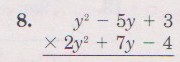
2y4 − 3y3 − 33y2 + 41y − 12 |
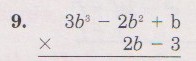
6b4 − 13b3 + 8b2 − 3b |
|
**Problem 5 is a special type of product. It is called the difference in perfect squares. The general form of this type of problem is (a + b)(a − b) = a2 − b2. Take a moment to go back and examine your calculations for this problem. You will note that the "outer" and "inner" products cancelled.
Another special type of product is when you are asked to square a binomial. The general forms for this type of product are:
(a + b)2 = a2 + 2ab + b2
(a − b)2 = a2 − 2ab + b2