Study Guide: Section 7-6
Solving Open Sentences with Absolute Value
An open sentence involving absolute value can be solved by rewriting it as an equivalent compound inequality:
- For all real numbers a and b, with b > 0, the expression |a| < b is equivalent to the compound sentence −b < a < b (an and sentence, representing the intersection of two conditions).
- For all real numbers a and b, with b > 0, the expression |a| > b is equivalent to the compound sentence a < −b or a > b (an or sentence, representing the union of two conditions).
Remember: On a number line, |x| represents the distance between x and 0. Distance is never negative.
Examples 1 & 2: Absolute Value Inequalities
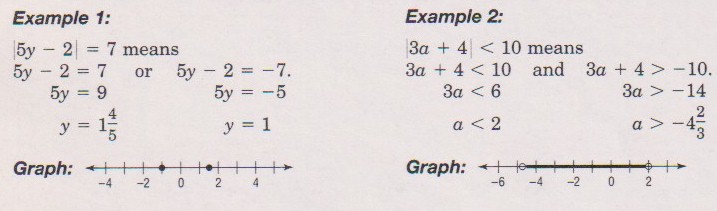
Example 3: Multi-Step Absolute Value Solutions

Practice Problems: Solve Each Open Sentence
x + 3 = 7 or x + 3 = −7
x = 4 or x = −10
Answer: {−10, 4}
−5 < y − 2 < 5
−3 < y < 7
Answer: {y | −3 < y < 7}
2a + 1 ≤ −9 or 2a + 1 ≥ 9
2a ≤ −10 or 2a ≥ 8
Answer: a ≤ −5 or a ≥ 4
−3 ≤ p − 6 ≤ 3
3 ≤ p ≤ 9
Answer: {p | 3 ≤ p ≤ 9}
3w − 2 < −13 or 3w − 2 > 13
3w < −11 or 3w > 15
Answer: w < −(11/3) or w > 5
The absolute value of a real number is never negative.
Answer: No solution (∅)
Absolute value is always non-negative (≥ 0).
Answer: No solution (∅)
Absolute value is non-negative for all real numbers.
Answer: All real numbers