These web-based activities were developed, during summer sessions from 1997 through 1999, by students at Mainland High School, located in Daytona Beach, FL. As part of Mainland's CCTT grant, the students were given permission by the book's publisher to convert the ancillary materials of the County's adopted Algebra 1 Textbook (Glencoe Algebra 1 - ISBN: 9780028253282) into html format.


Study Guide
Integration: Probability Compound Events


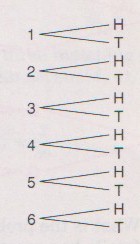
A compound event consists of two or more simple events. The probability of a compound event can be calculated if its outcomes are equally likely. To calculate probability, determine the possible outcomes. A tree diagram is a good way of doing this.


Example:

A die is rolled and a coin is tossed. What is the probability of getting a three on the die and heads on the coin?

To calculate the probabilty, you need to know how many outcomes are possible, There are 12 possible outcomes.

The probability of getting a three on the die and a heads on the coin is 1/12.

exTree


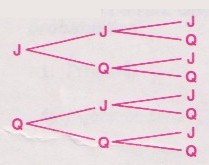
1. Max makes three piles of cards, each consisting of only a Queen and a Jack. Lisa draws one card from each pile. What is the probability that Lisa draws two Queens and a Jack in any order? Make a tree diagram of all the choices.

3/8 (see tree)


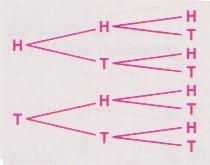
2. Phyllis drops three pennies in a wishing pond. What is the probability that only one lands with tails showing? Make a tree diagram of all the choices.

3/8 (see tree)


3. George has 1 pair of red socks and 1 pair of white socks in a drawer. What is the probability of drawing 2 red socks? Make a tree diagram of all the choices.

2/12 = 1/6 (see tree)


4. In exercise 3, what is the possibility of picking a red sock and a white sock in that order?

4/12 = 1/3 (see tree)


Copyright 1997-1999: html adaptation
Career Connection to Teaching with Technology