Study Guide A compound inequality consists of two inequalities that are connect by the words and or or.
Solving Compound Inequalities
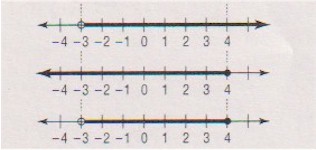
Example 1: x > −3 and x ≤ 4
The solution set, shown in the bottom graph, is {x| -3 < x ≤ 4} Remember that open circles denote < and > while solid circles denote ≤ and ≥. |
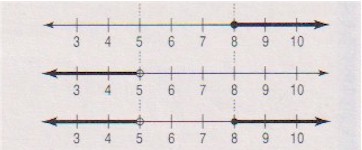
Example 2: t ≥ 8 or t < 5.
The solution set is {t| t ≥ 8 or t < 5} |
||||||||
Sometimes it is better to first solve each inequality and then graph the solution. Study the examples below.
|
|||||||||
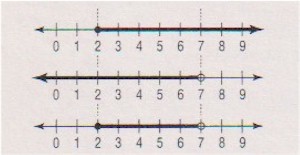
Example 3: −3 ≤ p − 5 < 2 Both "sides" of this compound inequality must be true, so the solution is their intersection.
|
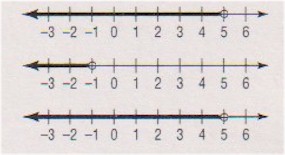
Example 4: 2a + 1 < 11 or a > 3a + 2 The solution to this compound inequality is the union of the solutions to each "side."
|
||||||||
|
|