Study Guide
Functions
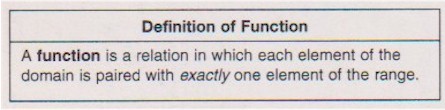
As stated in an earlier lesson, functions as a special type of relation.
Example 1: Is {(6, −3), (4, 1), (7, −2), (−3, 1)} a function? Is its inverse a function?
Since each element of the domain is paired with exactly one element of the range, the relation is a function.
However, its inverse is not a function since 1 is paired with more than one element of the range: the values of 4 and −3
inverse: {(−3, 6), (1, 4), (−2, 7), (1, −3)}
The equation y = 2x + 1 can be written as f(x) = 2x + 1.
If x = 3, then f(3) = 2(3) + 1 , or 7.
Thus, f(3), which is read "f of 3," is a way of referring to the value of y that corresponds to x = 3.
|
Example 2: If f(x) = 3x −4, find f(3) and f(−2)
f(3) = 3(3) − 4
f(3) = 9 - 4
f(3) = 5
|
|
f(−2) = 3(−2) − 4
f(−2) = −6 − 4
f(−2) = −10
|
|
Directions: Determine whether each relation is a function.
|

yes, yes, no
|

yes, no, yes
|

yes, no, yes
|
| Given f(x) = 2x - 4 and g(x) = x2 −4x, find each value. |

4, −4, −14, 21, −7/2 , −15/16
|