Study Guide: Section 5-2
Relations
A relation is a set of ordered pairs. The domain of a relation is the set of all first coordinates of the ordered pairs, and the range is the set of second coordinates.

Relations may be expressed in the form of ordered pairs, tables, graphs, and mappings:
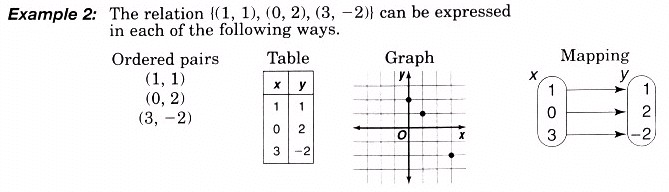
The inverse of any relation is obtained by switching the coordinates in each ordered pair.
Later in your study of mathematics, the term relation takes on a slightly different meaning once functions have been introduced. A function is defined as a relation that assigns each value of x to exactly one unique value of y.
Consequently the term relation is used to refer to a collection of points in which a value of x can be associated or paired with more than one value of y.
For example:
- The graphs of x = 2 and x = y2 are relations; while
- The graphs of y = 2 and y = x2 are functions, usually written with the notation f(x) instead of just y.
Practice Problems
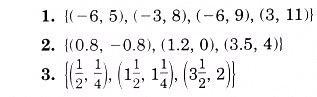
Directions: State the domain and range of each relation.
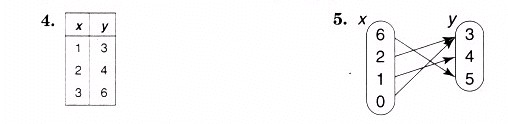
Directions: Express the relations shown in each table, mapping, or graph as a set of ordered pairs. Then state the domain, range, and inverse of the relation.
Directions: Draw a mapping and graph for each relation.
