Study Guide
Solving Quadratics by Using the Quadratic Formula
| The method of completing the square (Section 13-6) can be used to develop a general fromula called the quadratic formula that can be used to solve any quadratic function.
|
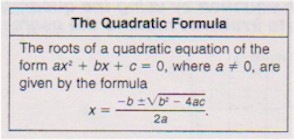 |
| The expression under the radical, b2 - 4ac, is called the discriminant. In order for the roots (aka, positions where the parabola crosses the x-axis) of a quadratic function to be real, the discriminant must be non-negative. If the disciminant is negative, then the parabola NEVER crosses the x-axis. |
Example: Use the quadratic formula to solve x2 − 6x − 2 = 0. 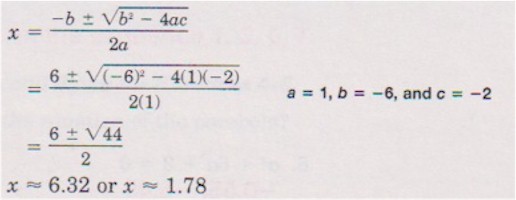
|
The ≈ tell you that the roots are approximately equal to the stated values. |
1. 4t2 = 144 −6, 6 |
2. 2x2 + 9x + 4 = 0 −4, −½ |
3. 8x2 + 17x + 2 = 0 −2 −⅛ |
4. 3z2 + 5z −2 = 0 −2, ⅓ |
5. −2m2 + 8m + 4 = 0 4.45, −0.45 |
6. x2 + 3x - 2 = 0 0.56, −3.56 |
7. 2x2 −6x + 4 = 0 1, 2 |
8. 5x2 + 10 = 15 −1, 1 |
2y2 −9y −3 = 0 4.81, −0.31 |
|