Study Guide: Section 11-2
Solving Quadratics by Graphing
A quadratic equation is an equation in which the value of the related quadratic function is 0. The solutions of a quadratic equation are called the roots.
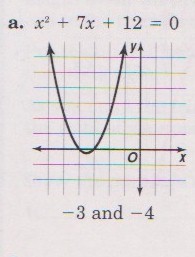
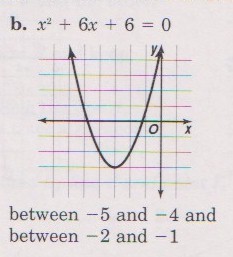
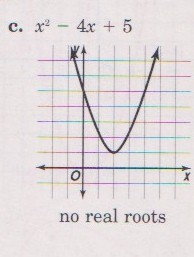
The roots of a quadratic equation can be found by graphing the related quadratic function and finding the x-intercepts or zeros of the function.
Examples
Solve each equation by graphing. If exact roots cannot be found, estimate the roots by stating the consecutive integers between which the roots lie:
Practice Problems
Directions: Solve each equation by graphing. If exact roots cannot be found, state the consecutive integers between which the roots lie.
1. x2 − x − 12 = 0
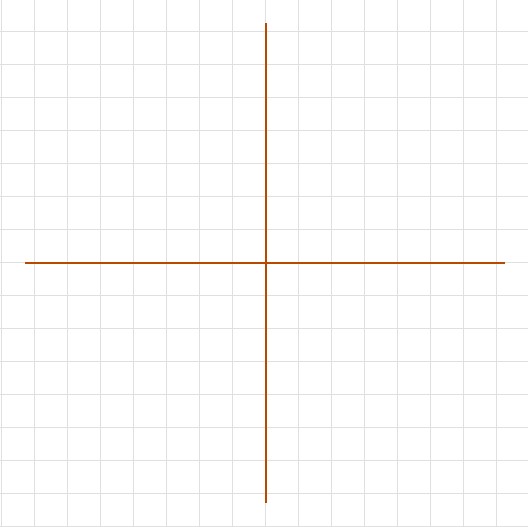
Roots: 4, −3
2. x2 + 4 = 0
No real roots
3. 4x2 − 12x + 3 = 0
0 < x < 1; 2 < x < 3
4. 4x2 = 35 − 4x
−4 < x < −3; 2 < x < 3