These web-based activities were developed, during summer sessions from 1997 through 1999, by students at Mainland High School, located in Daytona Beach, FL. As part of Mainland's CCTT grant, the students were given permission by the book's publisher to convert the ancillary materials of the County's adopted Algebra 1 textbook (Glencoe Algebra 1 — ISBN: 9780028253282) into html format.
Day 3 Classwork: A Study Guide to Understanding "Patterns"
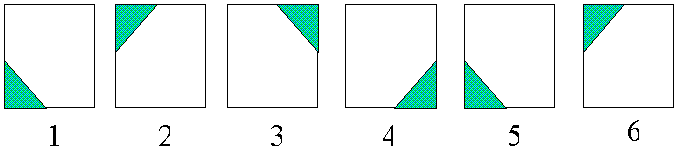
Study the pattern below.
Solutions:
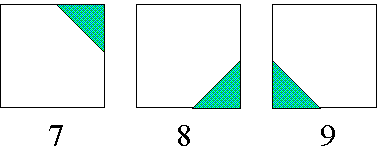
You may find a different pattern. For example, the seventh square may be the same as
the fifth square, the eighth square may be the same as the fourth square, and the ninth
square may be the same as the third square.
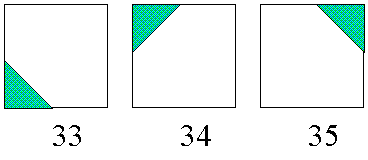
The 35th square will have its upper right corner shaded.
Numeric Patterns: The numbers 2, 4, 6, 8, 10, and 12 form a pattern called a sequence. A sequence is a set of numbers in a specific order. The numbers in the sequence are called terms.
Find the next three terms in each sequence.
a. 7, 13, 19, 25, … A study of the pattern in this sequence shows that the numbers increase by 6 units.
7 + 6 = 13, 13 + 6 = 19, 19 + 6 = 25The next three terms are 31, 37, and 43.
b. 243, 81, 27, 9, … Each term is 1/3 of the term before it.
243 * 1/3 = 81, 81 * 1/3 = 27, 27 * 1/3 = 9
The next three terms are 3, 1, and 1/3
9 * 1/3 = 3, 3 * 1/3 = 1, 1 * 1/3 = 1/3
Copyright 1997-1999: html adaptation
Career Connection to Teaching with Technology