Modeling Mathematics
Completing the Square
This activity corresponds to page 742 in your textbook.
One way to solve a quadratic equation is by completing the square. To use this method, the quadratic expression on one side of the equation must be a perfect square trinomial. You can use algebra tiles as a model for this technique.
Example 1: Use algebra tiles to complete the square for x2 + 4x + 1 = 0
Step 1: Subtract 1 from each side of the equation.
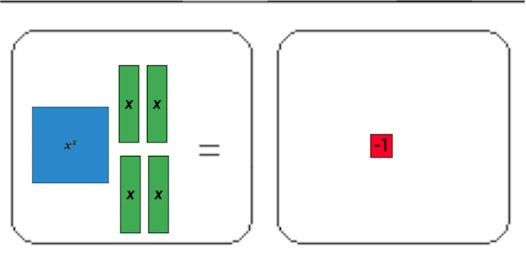
x2 + 4x + 1 − 1 = 0 − 1
x2 + 4x = −1
Model the equation x2 + 4x = −1 using tiles.
Step 2: Arrange the x2-tile and x-tiles into a square.
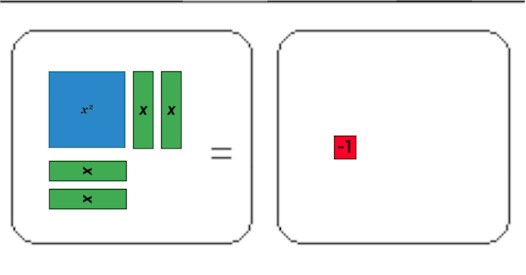
Step 3: In order to complete the square, add 4 positive 1-tiles to the left side of the mat. Add 4 positive 1-tiles to the right side to maintain equality.
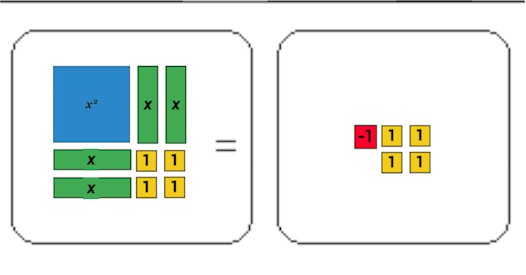
Step 4: Remove the “zero pair” on the right side. You have completed the square:
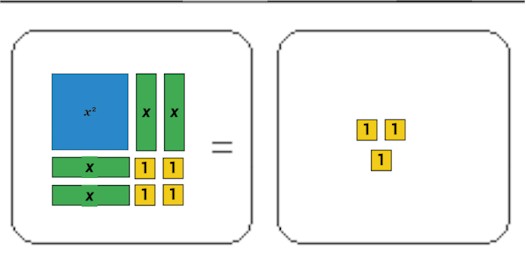
x2 + 4x + 4 = 3
(x + 2)2 = 3
Example 2: Use algebra tiles to complete the square for x2 − 6x + 5 = 0
Step 1: Subtract 5 from each side of the equation.
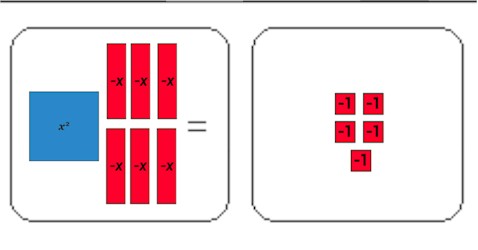
x2 − 6x + 5 − 5 = 0 − 5
x2 − 6x = −5
Step 2: Arrange the x2-tile and negative x-tiles into a square.
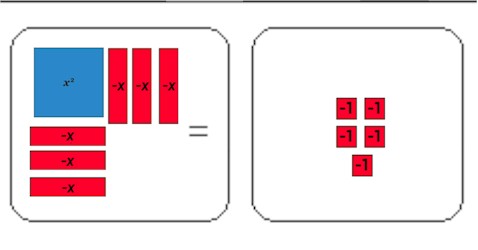
Step 3: Add 9 positive 1-tiles to both sides of the mat.
Why +9? Because (−6/2)2 = (−3)2 = +9.
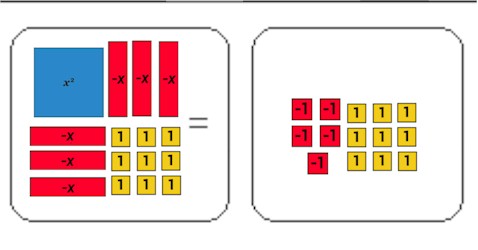
Why +9? Because (−6/2)2 = (−3)2 = +9.
Step 4: Remove the zero pairs. The completed square is:
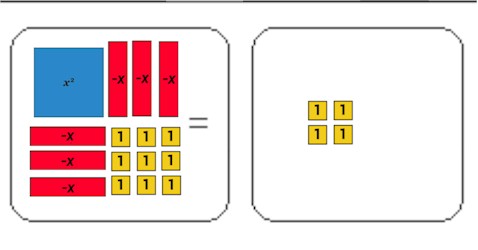
x2 − 6x + 9 = 4
(x − 3)2 = 4
Summary of Steps for Completing the Square
- Make sure that the coefficient of x2, a, equals 1. If not, divide the entire equation by a.
- Move the constant term to the other side of the equation.
- Divide the coefficient of x by 2 and square the result: (b/2)2.
- Add the squared value from Step 3 to both sides of the equation.
- Factor the left side — it is now a perfect square trinomial (x + b/2)2.
- Solve for x by taking the square root of both sides. Do not forget to include ± in front of the constant on the right side.