
Determining the Slope of a Staircase
These web-based activities were developed, during summer sessions from 1997 through 1999, by students at Mainland High School, located in Daytona Beach, FL. As part of Mainland's CCTT grant, the students were given permission by the book's publisher to convert the ancillary materials of the County's adopted Algebra 1 Textbook into html format.
Determining the Slope of a Staircase
|
To complete this activity, students need to work in groups of three. They need to locate five staircases for which they can measure both the total horizontal length and the complete vertical height. Try to vary the purpose of the chosen staircases: for instance, don't choose three exterior staircases all going from the first to second floor; maybe examine stairs located in an auditorium, a stage, a gym, an outside sitting area, or bleachers. Present your information in a comprehensive table. Materials:
|
| For each staircase, note its location and measure (in centimeters) its total length (run) and total height (run). ALERT: the careful of measuring from the "ends" of a meterstick/ruler. They are often not calibrated. | 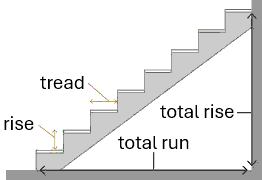 |
| Count the number of steps ... where the bottom landing counts at step 0, but the top landing counts as the final step. | |
| Measure the rise, or height, of each of the bottom two steps of each staircase. | |
| Measure the tread, or horizontal depth, of each of the bottom two steps of each staircase. | |
| Determine the slope of each staircase. | |
| Are some staircases steeper than others? Or do they all have the same slope? | |
| Do the first two steps have the same rise and tread? Are the stairs uniform? | |
| Research the local building code and determine if your school's staircases are compliant. | |
Copyright 1997-1999: html adaptation
Career Connection to Teaching with Technology