Background Information
Environmental
As Florida’s population increases, domestic wastewater
becomes a major source of pollution around densely populated urban areas, primarily in
central and southern Florida. Wastewater treatment facilities are then
overburdened by the demands of the growing community, leading to the dumping of partially
treated sewage water and treated sludge into
Florida's waterways. (Ocean
Planet) This sewage contains high concentrations of nitrogen and phosphorus and
is released into rivers and estuaries causing eutrophication or nutrient enrichment.(Ocean
Planet) This in turn leads to algal blooms,
oxygen depletion, and high turbidity detrimenting the aquatic life. Although some
would argue that the problem is inconsequential, or too expensive to correct, there is
evidence that accelerated eutrophication
has been responsible for the deaths of as many as 151 manatees in southwest Florida;
surprisingly, more deaths are caused by eutrophication than by boats. (Bay Journal) Furthermore,
portions of the contaminated water seep into the Floridan Aquifer polluting the primary
source of Florida's central water supply.(The Lake Doctors Inc.) |
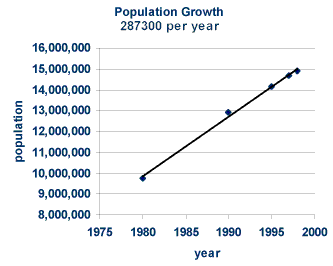 Built on
Statistical Data obtained from the Built on
Statistical Data obtained from the
US Census
Bureau
|
In addition to affecting increases in water pollution, stagnant wastewater
attributes to air pollution by emitting the greenhouse gas methane. Although
methane can be produced by the transportation, production, and combustion of coal, oil,
and gas, a large portion of the atmospheric methane is formed by the decomposition of
organic waste. (EPA) This decomposition occurs in both wastewater treatment
facilities and in landfills. The wastewater treatment process emits methane when
tanks of liquid waste containing high concentrations of organic materials are treated
anaerobically. This anaerobic digestion process is capable of releasing significant
quantities of methane if the digester is vented rather than recovered or flared. (EIA)
As wastewater treatment facilities exceed maximum capacity, some sewage is deposited in
local landfills. This is beneficial in that the amount of water contamination is reduced.
However, more importantly, it is harmful because the waste decomposes in landfills,
accounting for nearly 36% of the methane emissions in the United States.(CMU)
|
Water Pollution
When nutrient rich waste is released into aqueous
environments, algal blooms act to cover the surface of the water, blocking sunlight and
preventing the proliferation of seaweed. In addition, the increased eutrophication
depletes the amount of oxygen in the water. Deoxygenation occurs as the bacteria in
the aqueous environment extract dissolved oxygen to fuel the decomposition of
photosynthetic organisms. (Chesapeake
Bay) In time, this creates anoxic
conditions, killing fish, manatees, and other animals that depend on oxygen for cellular
respiration. These conditions are fairly common and have been observed in such
places as Lake Michigan and the Chesapeake Bay (Chesapeake
Bay
& Lake Michigan) These problems could potentially be solved
by Biomass to bio-gas conversions using anaerobic bacteria. This process can
effectively stop the growth of algae blooms by substantially decreasing the
portion of biomass that is allocated to landfills and dumped into the waterways.
The Floridan Aquifer is subject to direct infiltration or discharge of
pesticides, fertilizers, and high-nitrate sewage via overland runoff. |

Used with courtesy of
USF
About the picture: If we do not change the way we
manage our water, the natural beauty of Florida's lakes and rivers will be lost |
|
Major problems for the Floridan Aquifer result from the unconfined area in
which contaminating wastes are applied to the land surface. In addition, nearby
surface waters receive large quantities of nutrient-rich runoff. Pollutants carried
to the river by overland runoff from farms and dairies enter the Floridan Aquifer by river
water intrusion. This affects 44% of all consumed groundwater in Florida. (U.S.
Geological Survey) One hundred percent of water which is provided by public
works facilities comes from the Floridan Aquifer, threatening human and aquatic
life. Utilizing biomass conversions techniques epurate water,
resulting in potable
water. (Florida First)
About
the picture: Freshwater aquifers are Florida's primary source of drinking water
and are tapped by drilling wells. However, infiltration by pollutants may
deprive us of readily available water in a time when resources are scarce.
|
|

Used courtesy of
USF
|
Air Pollution
The greenhouse effect is a natural phenomenon that helps to regulate earth's temperature (EPA). Greenhouse gases act like the glass in an arboretum,
entrapping radiant heat while allowing ambient light to pass through the atmosphere.
Two of the major greenhouse gases are carbon dioxide and methane. Of these gases,
carbon dioxide accounts for over one-half the strengthening of the greenhouse effect at
present, while methane accounts for approximately one-sixth (University
of East Anglia) The greenhouse effect perpetrates increases in the torridity of
the atmosphere, creating world-wide environmental problems, global warming,
and melting the polar ice caps.
Today, nearly 85 percent of the world's 11 terawatts of energy is
generated by the combustion of fossil fuels. The problem is so serious that some
researchers believe that in order to reduce carbon emissions to a stable level by the
year 2050 there needs to be a tenfold increase in carbon-emission-free power generation.
(Health and Energy) Progressive power plants have begun using
biomass conversions to produce energy while effectively reducing the levels of carbon
dioxide emissions. Methane, although less common than carbon dioxide, is a
potent greenhouse gas, trapping is twenty-one times more heat than carbon dioxide
(EPA). As quantities of anthropogenic
gases increase, the expense of methane emissions will also rise. (IEAGHG)
Using biomass conversion prevents methane emissions from
landfills, |

Used courtesy of NASA GISS
| About
the picture: One of the major impacts of the ozone changes we attempt to predict
is the effect they will have on the amount of biologically harmful ultra-violet (UV)
radiation reaching the Earth's surface. |
|
capturing
the gas that indigenous anaerobic bacteria would change into methane, which
would escape into the atmosphere. Therefore, this is both an economically
and environmentally beneficial process. By utilizing anaerobic digestion and harnessing
methane gas to use as fuel, waste water treatment plants can meet government standards as
well as contribute to the environmental conservation effort. (EPA & Rensselaer)
|
|