http://www.swflorida.com/turtletime/lighting/intro.htm IntroductionLight from artificial sources differs markedly from other pollutants both in its form -- light is energy rather than substance -- and in its effect on sea turtles. Whereas heavy metal, petroleum, and other chemical pollutants produce predominately physical or physiological effects, the effect that light pollution has on sea turtles is essentially psychological. For sea turtles, artificial light is best described not as a toxic material but as misinformation. With its great potential to disrupt behaviors that rely on correct information, artificial lighting can have profound effects on sea turtle survival. Critical sea turtle behaviors affected by light pollution include the selection of nesting sites by adult turtles and the movement off the beach by hatchlings and adults. http://www.swflorida.com/turtletime/lighting.htm Executive Summary Although there is a tendency for turtles to prefer dark
beaches, many do nest on lighted shores, but in doing so, the lives of their hatchlings
are jeopardized. This threat comes from the way that artificial lighting disrupts a
critical nocturnal behavior of hatchlings -- crawling from their nest to the sea. On
naturally lighted beaches, hatchlings escaping from nests show an immediate and
well-directed orientation toward the water. This robust sea-finding behavior is innate and
is guided by light cues that include brightness, shape, and in some species, color. On
artificially lighted beaches, hatchlings become misdirected by light sources, leaving them
unable to find the water and likely to incur high mortality from dehydration and
predators. Hatchlings become misdirected because of their
tendency to move in the brightest direction, especially when the brightness of one
direction is overwhelmingly greater than the brightness of other directions, conditions
that are commonly created by artificial light sources. Artificial lighting on beaches is
strongly attractive to hatchlings and can cause hatchlings to move in the wrong direction
(misorientation) as well as interfere with their ability to orient in a constant direction
(disorientation).
Because there is no single, measurable level of
artificial brightness on nesting beaches that is acceptable for sea turtle conservation,
the most effective conservation strategy is to simply use "best available
technology" (BAT: a common strategy for reducing other forms of pollution by using
the best of the pollution-reduction technologies available) to reduce effects from
lighting as much as practicable. Best available technology includes many light-management
options that have been used by lighting engineers for decades and others that are unique
to protecting sea turtles. To protect sea turtles, light sources can simply be turned off
or they can be minimized in number and wattage, repositioned behind structures, shielded,
redirected, lowered, or recessed so that their light does not reach the beach. To ensure
that lights are on only when needed, timers and motion-detector switches can be installed.
Interior lighting can be reduced by moving lamps away from windows, drawing blinds after
dark, and tinting windows. To protect sea turtles, artificial lighting need not be
prohibited if it can be properly managed. Light is properly managed if it cannot be seen
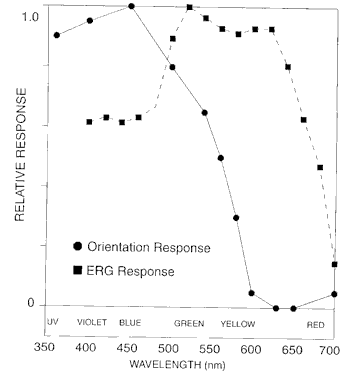
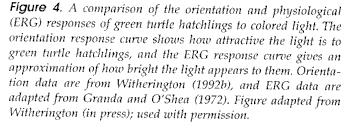
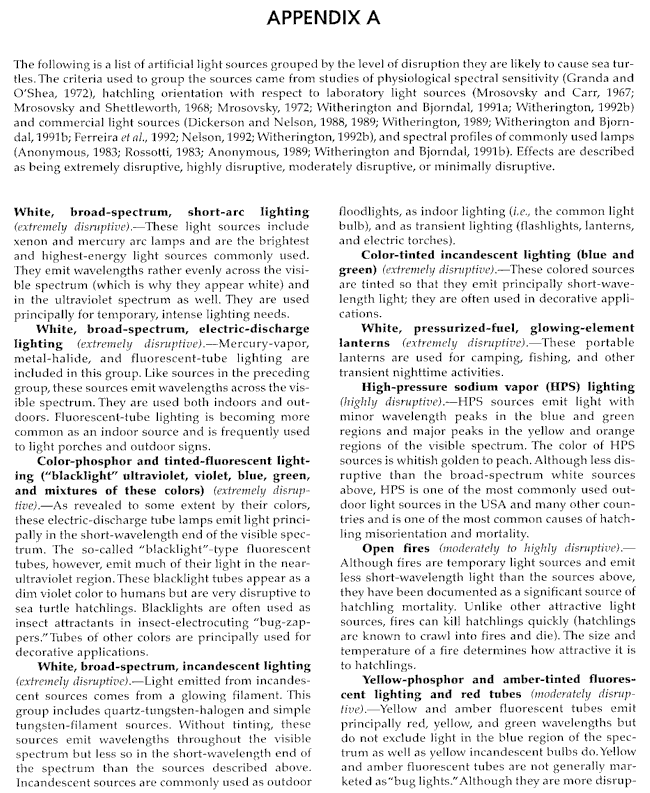
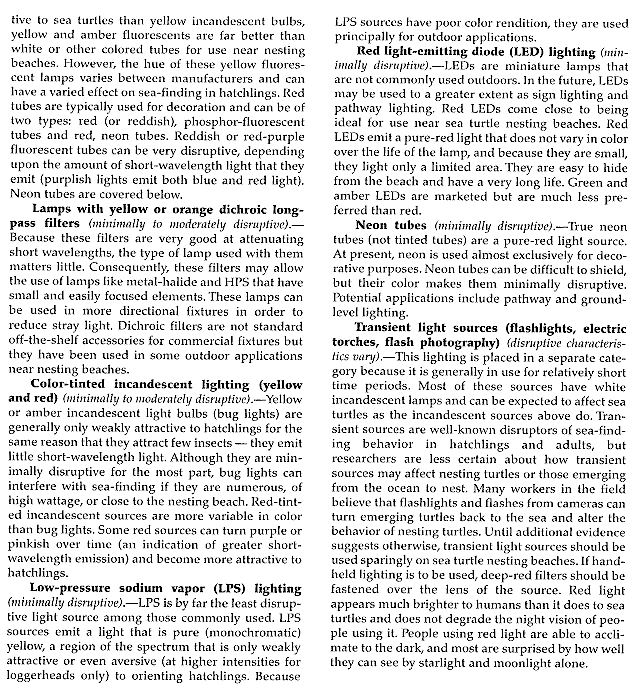
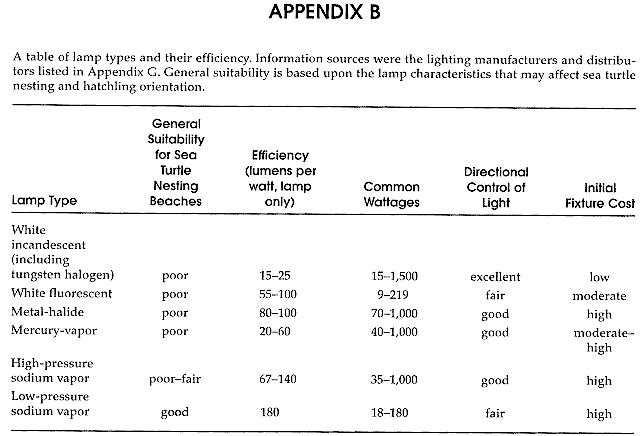
from the beach. A Model for Measuring Brightness Researchers have learned much about sea turtles' perception of brightness by using a procedure called electroretinography (ERG) to measure the relative electrical potential across retinas of turtles exposed to different wavelengths of light. ERG data show that green turtles are most sensitive to light in the violet to orange region of the visible spectrum, from 400 to 640 nm (Figure 4; Granda and O'Shea, 1972). In daylight, green turtles show a greater spectral sensitivity within the shorter-wavelength (blue) region of the spectrum than humans do.
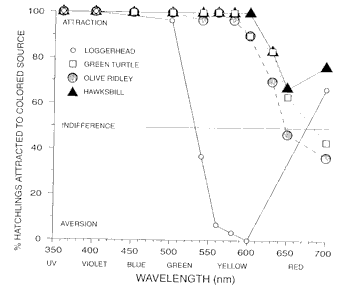
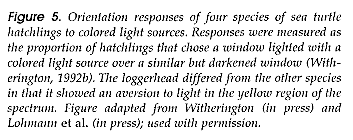
Although ERG data provide important physiological information, the most direct way to determine the effects of spectral light on orientation is to conduct behavioral experiments. The earliest studies on hatchlings' responses to light wavelength employed broad-band (multiple-wavelength-transmission) filters to vary the wavelengths that reached orienting hatchlings (Mrosovsky and Carr, 1967; Mrosovsky and Shettleworth, 1968). Although reactions to specific wavelengths could not be determined, it was clear that the green turtle hatchlings studied were more attracted to blue light than to red light. In later experiments, researchers used narrow-band (monochromatic) filters to vary the wavelengths reaching loggerhead, green turtle, hawksbill, and olive ridley hatchlings (Witherington and Bjorndal, 1991a; Witherington, 1992b). The use of monochromatic filters allowed a simple measure of light intensity so that researchers could determine the responses of hatchlings to a set number of photons at each of several wavelengths. As in previous experiments, hatchlings showed a preference for short-wavelength light. Green turtles, hawksbills, and olive ridleys were most strongly attracted to light in the near-ultraviolet to yellow region of the spectrum and were weakly attracted or indifferent to orange and red light (Figure 5).
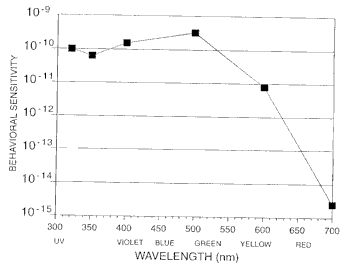
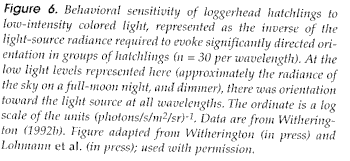
Loggerheads were most strongly attracted to light in the near-ultraviolet to green region and showed an unexpected response to light in the yellow region of the spectrum. At intensities of yellow light comparable to a full moon or a dawn sky, loggerhead hatchlings showed an aversion response to yellow light sources (Figure 5), but at low, nighttime intensities, loggerheads were weakly attracted to yellow light (Figure 6). It may be that the hatchlings cannot discriminate color at low light levels. This is common for animals (such as turtles) that have rod-and-cone retinas (Granda and Dvorak, 1977).
It should come as no surprise that humans and sea turtle
hatchlings see the world differently. For most of their lives, sea turtles see the world
through a blue ocean filter (water selectively absorbs reddish, long-wavelength light), so
it makes sense that sea turtles would be most sensitive to short-wavelength light.
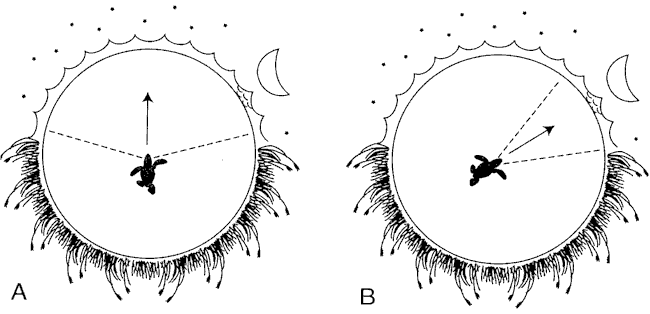
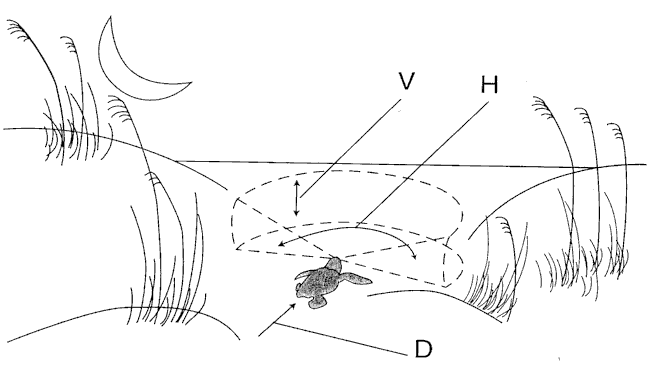
The horizontal component of the acceptance cone for green
turtle and olive ridley hatchlings (Verheijen and Wildschut, 1973) and for loggerhead
hatchlings (Witherington, 1992b) has been deduced from the way that hatchlings orient in
controlled light fields. In these studies, light fields were artificially controlled so
that detectors with different acceptance-cone widths measured different brightest
directions. Hatchlings of each species typically oriented in the brightest direction as it
would be measured with a wide acceptance cone, approximately 180° horizontally.
Again, we see that the attributes of this hypothetical detector differ from those of most light meters. The most commonly found light meters, illuminance meters, measure light with an acceptance cone that is less flattened and not as wide as the acceptance cone that hatchlings use. Another type of light meter, a luminance or "spot" meter, measures light with a very narrow acceptance cone. Careful consideration should be given to the directional attributes of a light-measuring instrument if its measurements are to be used in predicting hatchling behavior.
|